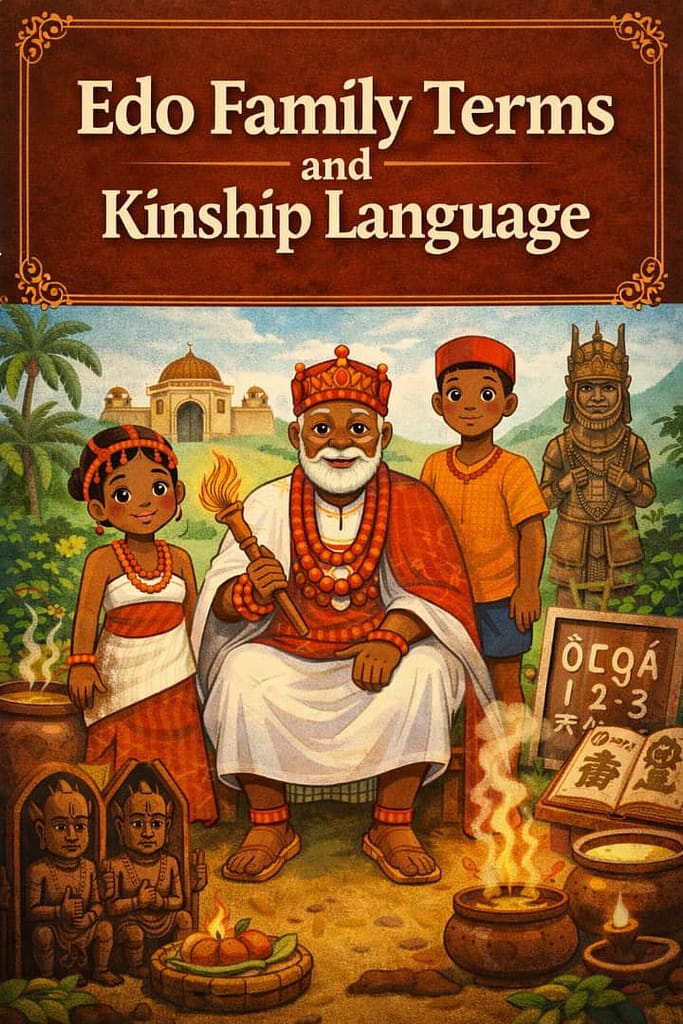
Edo Family Terms and Kinship Language
Family is the cornerstone of Edo society. Among the Edo people of present-dayEdo State and surrounding regions, kinship defines identity, social behavior,inheritance, authority, and moral responsibility. Edo family terms and kinshiplanguage are integral to how relationships are formed, maintained, andrespected.Unlike Western systems that emphasize the nuclear family, Edo kinship operateswithin an expansive framework that includes extended family, lineage, ancestors,and affinal relations (relations through marriage). Kinship terms are used daily ingreetings, conflict resolution, rituals, ceremonies, and governance. A child learnskinship language early, not only to identify relatives but to understand properconduct, respect, and obligation.This article provides a comprehensive exploration of Edo family terms and kinshiplanguage, tracing their structure, meanings, functions, and enduring relevance incontemporary Edo society.The Edo People and Language BackgroundThe Edo PeopleThe Edo people are indigenous to southern Nigeria, historically associated withthe Benin Kingdom—one of Africa’s most sophisticated pre-colonial states. Theirculture is known for its centralized monarchy (the Oba of Benin), advanced arttraditions, and strong social institutions.Edo LanguageEdo language belongs to the Edoid group of the Niger-Congo language family.Kinship terminology in Edo is deeply embedded in the language’s tonal,contextual, and hierarchical structure. Words for family relations often carryimplicit meanings about age, authority, gender, and social distance.The Edo Concept of FamilyFamily as a Social InstitutionIn Edo worldview, family (often understood as egbe or lineage-based units) ismore than blood ties. It includes:
Edo Family Terms and Kinship Language Lire la suite »