
LESSON 1: THE ỌBA, CHIEFS AND THE PEOPLE
Understanding the Political Structure of the Kingdom of Benin
ẸDOMAYE ACADEMY
Preserving Culture & Empowering Education
INTRODUCTION
The Kingdom of Benin was one of the great civilizations of precolonial Africa.
Its history is often introduced through the Ọba, the royal palace, Benin bronzes, great walls and earthworks, or famous historical events.
But there is something every learner must understand first:
The Ọba did not govern the kingdom alone.
Benin developed a complex political system involving the Ọba, chiefs, palace institutions, community leaders, military commanders, royal women and the wider population.
This lesson introduces that system.
1. WHO IS THE ỌBA?
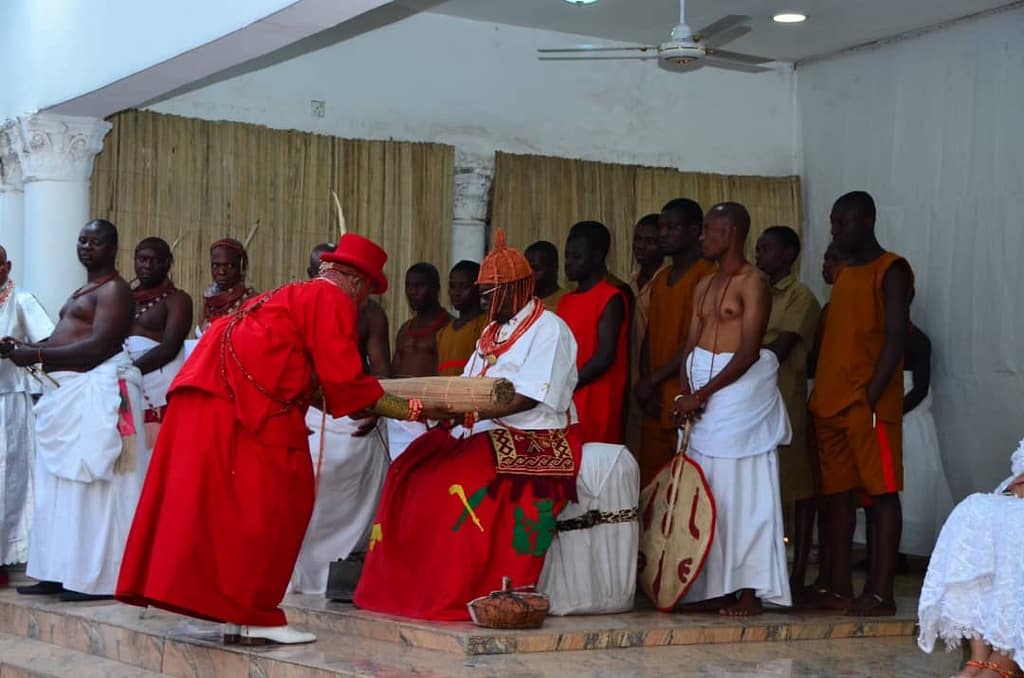
The Ọba is the traditional king of Benin.
The Ọba stands at the centre of the traditional political and cultural institution of the Benin Kingdom.
The throne represents:
- Kingship
- Political authority
- Cultural continuity
- Traditional leadership
- Royal responsibility
- The preservation of heritage
However, the Ọba’s authority operated within a wider network of institutions.
Therefore, to understand Benin kingship, we must understand the people and institutions surrounding the throne.
2. WHO WERE THE CHIEFS?
The chiefs were important holders of traditional offices within the Benin political system.
Different chiefs had different responsibilities.
Some were connected with the royal palace.
Some exercised authority within communities.
Some were associated with military organization.
Others had ceremonial, administrative or other traditional responsibilities.
The word chief therefore does not describe one single office.
It represents a broad range of institutions and titles that developed over the history of Benin.
3. THE THREE IMPORTANT GROUPINGS
Traditional accounts commonly identify major groupings of Benin chiefs, including:
UZAMA
The Uzama are among the important hereditary chiefly institutions associated with the history of Benin kingship.
EGHAEVBO N’OGHE
The Eghaevbo n’Oghe are associated with palace-based chiefly institutions.
EGHAEVBO N’ORE
The Eghaevbo n’Ore are associated with town and community chiefly institutions.
These groups should not be treated as identical.
Each has its own history, titles and responsibilities.
4. THE EZOMO
Another important institution is the Ezomo.
The Ezomo is strongly associated with Uzebu and with military leadership in Benin historical traditions.
This is particularly important because the Ezomo appears in the traditional history surrounding Princess Adesuwa and Ọba Akengbuda.
The Ezomo therefore gives us an example of how political, military and community authority could intersect within Benin society.
5. THE PEOPLE OF THE KINGDOM
The history of Benin was not made by the Ọba and chiefs alone.
The kingdom depended upon its people.
Farmers produced food.
Craftspeople produced objects and tools.
Traders moved goods.
Warriors defended the kingdom.
Families preserved genealogies and traditions.
Communities maintained their local institutions.
Artists, metalworkers, carvers and other specialists contributed to Benin’s extraordinary cultural achievements.
The kingdom was therefore a society made up of many interconnected groups.
6. THE PALACE
The Benin royal palace was much more than the private residence of the king.
It was a major political and cultural centre.
Royal ceremonies took place there.
Important decisions were made there.
Chiefs performed their responsibilities there.
Royal traditions were maintained there.
The palace therefore represented the centre of the Benin political system.
But the authority of the palace extended into the wider kingdom through the network of chiefs and communities.
7. HOW THE SYSTEM WORKED
We can simplify the structure for learning purposes:
ỌBA
↓
CHIEFS & PALACE INSTITUTIONS
↓
COMMUNITIES & LOCAL LEADERS
↓
THE PEOPLE
This does not mean that every relationship in Benin society was simply vertical.
Different institutions possessed different forms of authority.
But the diagram helps us understand one important principle:
Benin was governed through institutions, not by the Ọba acting alone.
8. WHY THE CHIEFS WERE IMPORTANT
Imagine a kingdom where every decision had to be carried out personally by the king.
Such a system would be extremely difficult to operate.
The chiefs and other institutions helped make governance possible.
They helped connect:
The palace → communities
and
The communities → the palace.
They could transmit decisions, maintain responsibilities, organize activities and preserve traditions.
This institutional structure contributed to the stability and continuity of the kingdom.
9. BENIN WAS A COMPLEX CIVILIZATION
This is one of the most important lessons.
Benin should not be presented as a simple traditional society.
It developed:
- Political institutions
- Royal administration
- Military organization
- Specialized titles
- Palace institutions
- Community leadership
- Skilled industries
- Long-distance relationships
- Complex cultural traditions
- Systems of historical memory
The kingdom’s achievements were therefore the product of a sophisticated civilization.
10. WOMEN IN THE SYSTEM
Women were also part of the political and cultural life of Benin.
Royal women held important positions within the palace.
The title Oloi refers to a wife of the Ọba.
Women also preserved family histories, language, traditions and cultural knowledge.
The story of Oloi Idẹn, associated with the reign of Ọba Ewuakpe, demonstrates how the memory of a woman could become part of the wider historical tradition of the kingdom.
Therefore, the history of Benin must never be told only through men.
11. WHAT HAPPENS WHEN INSTITUTIONS CONFLICT?
The traditional history of Ọba Ewuakpe provides an important example.
His reign is remembered as a period of serious political crisis.
The relationship between the palace and important political authorities became strained.
The traditional story of Oloi Idẹn is connected with the eventual restoration of peace.
Whether every detail of the tradition can be independently verified is a matter for further historical research.
But the lesson is clear:
Institutions are essential to the stability of a kingdom.
12. WHAT CAN WE LEARN TODAY?
The history of Benin teaches us that leadership is not only about one person.
Strong societies require:
Institutions.
Responsibilities.
Leadership.
Community participation.
Cultural memory.
Education.
A society becomes stronger when knowledge is transmitted from one generation to another.
That is why Ẹdomaye exists.
CLASS ACTIVITY
Answer the following questions.
QUESTION 1
Who stood at the centre of the traditional political system of the Benin Kingdom?
QUESTION 2
Why were chiefs important?
QUESTION 3
Name three major groupings of Benin chiefs.
QUESTION 4
What is the Ezomo associated with?
QUESTION 5
Why was the royal palace important?
QUESTION 6
What does the title Oloi mean?
QUESTION 7
Why should Benin history not be told only through the stories of kings?
THINK ABOUT IT
If the Ọba was the centre of the kingdom, but the Ọba did not govern alone, what does this tell us about the sophistication of the Benin political system?
Discuss your answer with your classmates.
KEY WORDS
Ọba — King of Benin.
Oloi — Wife of an Ọba.
Uzama — An important group of hereditary chiefly institutions.
Eghaevbo n’Oghe — Palace-associated chiefly institutions.
Eghaevbo n’Ore — Town/community-associated chiefly institutions.
Ezomo — A major Benin title associated particularly with Uzebu and military leadership.
Palace — The central royal institution of Benin kingship.
Heritage — The cultural, historical and material inheritance passed from one generation to another.
LESSON SUMMARY
The Kingdom of Benin was not governed by the Ọba alone.
The Ọba stood at the centre of a complex system of chiefs, palace institutions, military organizations, communities and families.
The chiefs helped connect the royal centre with the wider society.
The people sustained the kingdom through agriculture, trade, craftsmanship, military service, cultural production and community life.
Women also played important roles in royal and cultural history.
Understanding this system is essential before studying individual Benin kings and historical events.
NEXT LESSON
LESSON 2:
THE BENIN ROYAL PALACE
What was the palace?
How did it function?
Who lived and worked there?
Why was it so important to Benin kingship?
That is where our next lesson begins.
ẸDOMAYE ACADEMY
Preserving Culture & Empowering Education
WE ARE IN BENIN
Learn the language.
Know the history.
Understand the institutions.
Preserve the heritage.
Teach the next generation.
ẸDOMAYE — Preserving Culture & Empowering Education.
The leopard roars.
The memory lives.
The heritage continues.

Author: Otọdede James Ibieorutomwen
Otodede James Ibieorutomwen is the Founder and Executive Director of Ẹdomaye Legacy Foundation, a cultural and educational initiative dedicated to preserving, researching, documenting, and promoting the history, heritage, language, and cultural identity of the Great Benin Kingdom. Known as OTO THE WRITER, he is an Edo/Benin language teacher, researcher, writer, and lifelong student of Edo/Benin history and culture. Through Ẹdomaye Legacy Foundation, he is developing educational resources, eBooks, language-learning initiatives, cultural documentation, and research projects designed to make Edo/Benin knowledge accessible to present and future generations. His work is guided by a commitment to evidence-based research, cultural preservation, indigenous knowledge, and the responsible transmission of Edo/Benin language and heritage. ONLY THE BEST IS GOOD ENOUGH FOR ẸDOMAYE LEGACY FOUNDATION.