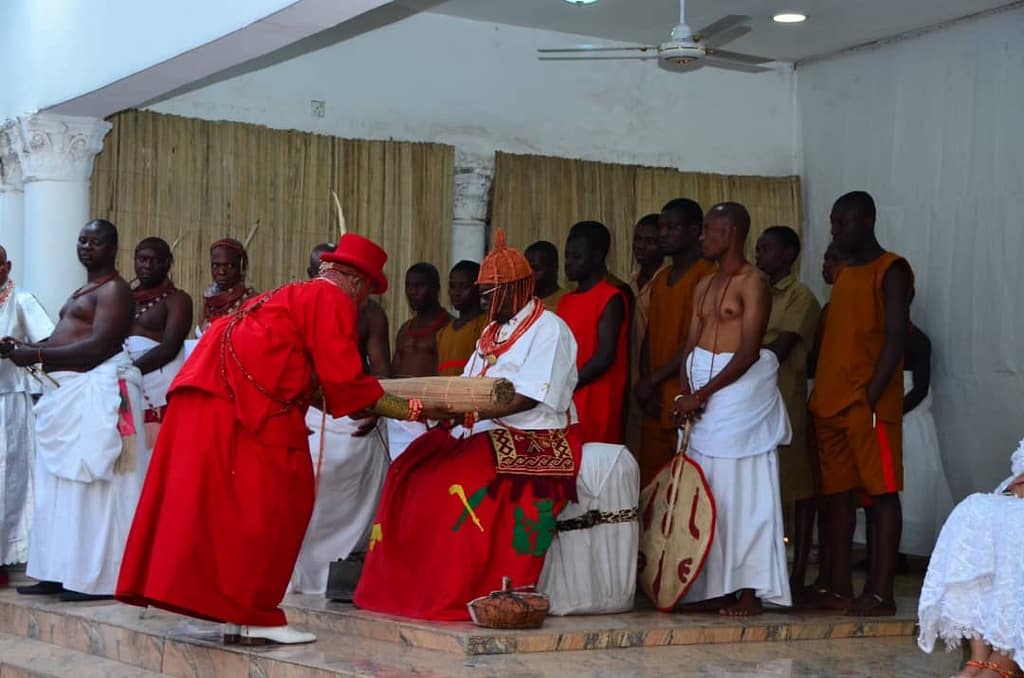

The Ẹdo/Benin morning family salutation known as ÙKHÙ is not merely an ordinary greeting.
It can carry information about family identity, ancestry, communal background and/or place of origin.
This is not simply an internet claim.
It is documented in a 2020 University of Benin linguistic study by Osaigbovo Obed Evbuomwan and William Ighasere Aigbedo, Department of Linguistics Studies, University of Benin.
🔴 THE RESEARCH DATA
The researchers collected data from 100 Ẹdo speakers from different family and communal backgrounds across:
• Oredo
• Egor
• Ikpoba-Okha
• Orhionmwon
• Ovia North-East
• Ovia South-West
• Uhunmwode
Their study identified 60 different ÙKHÙ salutations in the research corpus.
⚠️ IMPORTANT ACADEMIC CORRECTION:
The published article does NOT print a numbered master list of all 60 terms.
Therefore, nobody should manufacture a “UNIBEN 1–60 list” and falsely claim that the University published it.
What we can responsibly present are the ÙKHÙ forms that the published paper explicitly discusses and analyses.
📜 FORMS EXPLICITLY DOCUMENTED IN THE PAPER
Lá- forms
Lámógùn
Láínì
Láúgìè
Lágìté
Láùvbè
Láìrén
Lámókùn
Lámódu
Lámùkó
Láréndò
Dè-Lá forms
Dèláìkù
Dèlákùn
Dèláùhè
Dèláìhòn
Dèláìhè
Dèlágùn
Dèlálù
Dèlárù
Other forms explicitly analysed
Láméré
Láògèlè
Lágièsàn
Láẹ̀bò
Dèláínì
Láúghà
Lámólù
Lámórù
Lámèrì
Dèláéhò
Láìré
Lálókè
Lágièrrùà
Láòsò
Lávbiézè
Dèláòsò
Lámósùn
Láìdù
Dèláìhè
Some forms occur in more than one analytical category, so these examples must not simply be added together and called “the 60.”
🧬 WHAT DOES THE RESEARCH SHOW?
The study found that ÙKHÙ terms are generally built around:
(Dè-) + Lá- + ROOT
The root is associated with an important personality, place, deity, or position of authority connected with the history and identity of the group using the salutation.
The researchers therefore treat ÙKHÙ as an honorific expression whose forms preserve historical and cultural information.
🔥 THIS IS THE BIG POINT
A family salutation can therefore function as a cultural identity marker.
When an Ẹdo person gives a traditional ÙKHÙ, that word may point beyond the individual being greeted — toward lineage, historical association, ancestral identity, place of origin, authority or communal affiliation.
And there is another important point:
One ÙKHÙ is not necessarily exclusive to only one family.
The research specifically documents cases where a salutation is shared by more than one group.
So we must distinguish between:
“This is our family salutation.”
and
“This salutation belongs exclusively to only our family.”
They are not automatically the same claim.
🏛️ OUR POSITION AT ẸDOMAYE LEGACY FOUNDATION
We will preserve Ẹdo/Benin heritage with evidence.
NO INVENTION.
NO FALSE ATTRIBUTION.
NO ALTERING OF ORIGINAL FORMS.
NO TURNING ORAL HISTORY INTO FICTION.
Where the University of Benin has documented it, we cite the research.
Where the complete underlying field dataset has not been published, we say so honestly.
That is how serious cultural preservation is done.
📚 PRIMARY RESEARCH SOURCE
Evbuomwan, Osaigbovo Obed & Aigbedo, William Ighasere (2020).
“The Internal Structure of the Ẹdo Family Salutation (ÙKHÙ).”
University of Benin Journal of the Humanities, Vol. 8, No. 1.
The published research records 60 ÙKHÙ terms from 100 Ẹdo speakers.
The complete numbered 60-item field corpus is not printed in the article, so the responsible scholarly position is to distinguish the 60-term research corpus from the individual examples actually published and analysed.
🔥 THIS IS THE RECORD.
WE ARE IN BENIN.
ẸDOMAYE LEGACY FOUNDATION
Forward ever, backward never.

Author: Edomaye Legacy Foundation
Edomaye Legacy Foundation preserves and promotes Edo language, culture, and heritage for learners and future generations. Through digital education, storytelling, and community programs, we ensure Edo traditions and knowledge are actively learned, celebrated, and passed on. Forward ever, backward never.