
LESSON 2: THE BENIN ROYAL PALACE
The Heart of Benin Kingship
ẸDOMAYE ACADEMY
Preserving Culture & Empowering Education
INTRODUCTION
When we hear the word palace, we may imagine a beautiful residence belonging to a king.
But the Royal Palace of Benin was much more than a residence.
It was a political institution.
It was a ceremonial centre.
It was a cultural centre.
It was a place where royal authority was expressed and where important traditions were maintained.
To understand the Kingdom of Benin, we must therefore understand the institution of the palace.
1. WHAT IS THE BENIN ROYAL PALACE?
The Benin Royal Palace is the traditional centre of the institution of Benin kingship.
It is associated with the Ọba, the royal household, chiefs, ceremonies and important aspects of Benin political and cultural life.
The palace should therefore be understood not simply as a building.
It represents an institution that has developed and changed through generations of Benin history.
2. THE PALACE AND THE ỌBA
The Ọba is at the centre of Benin kingship.
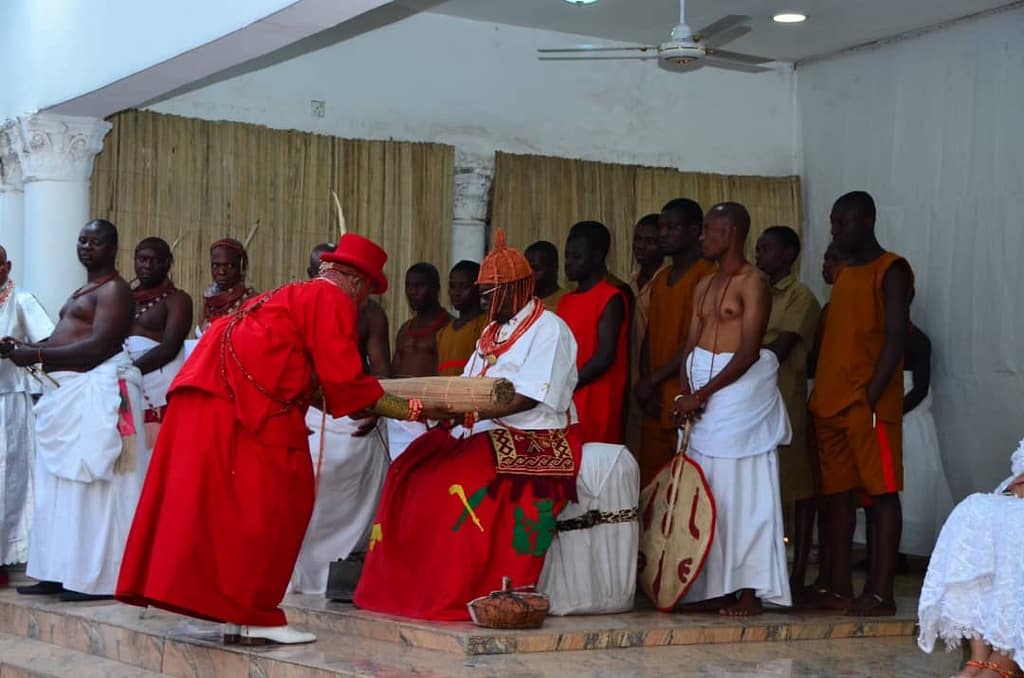
The palace provides the traditional setting in which much of the public and ceremonial life associated with the monarchy takes place.
Royal authority is expressed through:
- Ceremonies
- Traditional titles
- Palace institutions
- Royal rituals
- Meetings
- Cultural traditions
- Communication with chiefs and communities
The palace therefore became a visible symbol of continuity.
3. THE PALACE WAS NOT JUST A HOME
This is one of the most important things to remember.
The Benin Palace was not simply the private home of a king.
It functioned as a centre of governance and tradition.
Important royal activities were connected with it.
Chiefs had responsibilities associated with the palace.
Royal ceremonies were conducted there.
Members of the royal household lived within its institutional environment.
Traditions were transmitted through generations.
4. WHO WAS CONNECTED WITH THE PALACE?
The palace involved many people.
These included:
The Ọba
Oloi
Palace chiefs
Royal family members
Traditional officials
Servants and specialists
Craftspeople
Ceremonial participants
Each person had a role within the larger institution.
This demonstrates again that Benin kingship was not based upon the Ọba acting alone.
5. THE PALACE CHIEFS
Some Benin chiefs were closely connected with the royal palace.
These institutions helped the palace function.
They carried out responsibilities associated with administration, ceremonies, communication and other traditional duties.
This is why Lesson 1 introduced the Eghaevbo n’Oghe.
To understand palace government, students must understand the people who operated within its institutional structure.
6. THE PALACE AND ROYAL WOMEN
Women were an important part of palace life.
The title Oloi refers to a wife of the Ọba.
The Oloi belonged to the royal household and formed part of the social and cultural world of the palace.
The history of Benin’s royal women deserves serious study because women were not merely background figures.
Their stories form part of the history of the monarchy itself.
7. THE PALACE AND CEREMONY
Ceremony has always been important to Benin kingship.
Royal ceremonies communicate history and identity.
They can preserve:
- Genealogy
- Political relationships
- Religious traditions
- Royal authority
- Community identity
- Historical memory
Ceremony therefore does more than create spectacle.
It transmits knowledge.
8. THE PALACE AND ART
The Benin royal court became internationally famous for its extraordinary artistic traditions.
Benin artists produced remarkable works in:
Bronze and brass
Ivory
Wood
Coral
Beads
Textiles
and other materials.
Many works were associated with the royal court and helped preserve the memory of kings, chiefs, royal events and important historical traditions.
The art was therefore not merely decoration.
It could function as a form of historical memory.
9. THE PALACE AND HISTORY
Before modern recording technologies, societies preserved knowledge through many different methods.
Benin used:
Oral tradition
Genealogy
Ceremony
Art
Architecture
Names
Titles
Places
The palace was one of the major environments where these forms of memory were connected.
This is why studying the palace can help us understand the wider civilization.
10. THE PALACE AND POLITICAL AUTHORITY
A king’s authority must be recognized by institutions and communities.
The palace represented the centre of royal authority.
But the authority of the palace extended beyond its physical boundaries.
Chiefs carried responsibilities.
Communities maintained relationships with the centre.
Military institutions supported the kingdom.
Royal ceremonies reinforced the institution of kingship.
The palace therefore functioned as a centre within a much larger political network.
11. THE PALACE AND THE PEOPLE
The palace did not exist separately from society.
The kingdom depended upon its people.
Farmers produced food.
Craftspeople produced objects.
Traders participated in economic networks.
Communities maintained local institutions.
Specialists served the royal court.
The palace was therefore connected to the wider economic and social life of Benin.
12. THE PALACE THROUGH HISTORY
The Benin Palace has experienced historical change.
The most famous turning point in modern history was the British invasion of Benin in 1897.
The city was attacked and the royal palace was affected during the destruction and looting that followed.
Many royal objects and artworks were taken from Benin and dispersed to institutions and private collections around the world.
This event remains central to discussions about Benin heritage, restitution and the return of cultural objects.
13. THE 1897 INVASION
The events of 1897 profoundly affected Benin.
The British military expedition resulted in the destruction and looting of the royal city.
The Oba was removed from the throne and exiled.
Royal artworks and sacred or ceremonial objects were taken away.
Many of these objects are today found outside Nigeria.
This is one reason the history of the Benin Palace cannot be separated from the modern global debate over cultural heritage.
14. THE PALACE TODAY
The institution of the Benin monarchy survived the events of 1897.
The traditional institution continues.
The palace remains an important symbol of Benin identity and cultural continuity.
For modern generations, the palace represents a connection between:
Past
and
Present.
It reminds us that Benin history did not end in 1897.
The heritage continues.
15. WHY THE PALACE MATTERS TO ẸDOMAYE
Ẹdomaye is dedicated to preserving culture and empowering education.
The Benin Palace is therefore central to our mission.
When we teach the palace, we are teaching:
Kingship
History
Language
Art
Political institutions
Royal traditions
Cultural memory
Heritage preservation
Students should understand that heritage is not simply something displayed in museums.
Heritage can be living.
16. THE PALACE AS A CLASSROOM
Imagine entering the Benin Palace as a student of history.
Every title raises a question.
Every ceremony carries a memory.
Every object can tell a story.
Every royal name connects one generation to another.
Every traditional word contains cultural knowledge.
This is why the palace can become a classroom without walls.
CLASS ACTIVITY
Answer the following questions.
QUESTION 1
What is the Benin Royal Palace?
QUESTION 2
Why was the palace more than the residence of the Ọba?
QUESTION 3
Who is an Oloi?
QUESTION 4
Why were chiefs important to the palace?
QUESTION 5
How did Benin art help preserve historical memory?
QUESTION 6
What happened to the Benin Palace and royal city during the events of 1897?
QUESTION 7
Why is the palace still important today?
THINK ABOUT IT
If the Benin Palace represents more than a building, what does it represent?
Write three things you believe the palace represents to the people of Benin today.
KEY WORDS
Ọba — King of Benin.
Oloi — Wife of an Ọba.
Palace — The central traditional institution associated with Benin kingship.
Chief — Holder of a traditional title or office.
Royal Court — The wider institutional and social environment surrounding the monarchy.
Heritage — Cultural and historical inheritance passed from one generation to another.
Restitution — The return of cultural property to its rightful owners or source communities.
LESSON SUMMARY
The Benin Royal Palace was much more than the residence of the Ọba.
It was a centre of kingship, ceremony, political authority and cultural memory.
The palace was connected to chiefs, Oloi, royal family members, artisans, officials and communities.
Benin’s artistic traditions also helped preserve the memory of the royal institution.
The events of 1897 profoundly affected the palace and resulted in the removal and dispersal of many Benin cultural objects.
Yet the institution of Benin kingship survived.
The palace therefore remains an important symbol of continuity.
NEXT LESSON
LESSON 3:
THE UZAMA — THE HEREDITARY CHIEFS OF BENIN
Who were the Uzama?
How did their authority develop?
What was their relationship with the Ọba?
Why are hereditary institutions important to understanding Benin political history?
That is our next lesson.
ẸDOMAYE ACADEMY
Preserving Culture & Empowering Education
WE ARE IN BENIN
Know the palace.
Know the institutions.
Know the history.
Know the language.
Preserve the heritage.
Teach the next generation.
ẸDOMAYE — Preserving Culture & Empowering Education.
The leopard roars.
The memory lives.
The heritage continues.

Author: Otọdede James Ibieorutomwen
Otodede James Ibieorutomwen is the Founder and Executive Director of Ẹdomaye Legacy Foundation, a cultural and educational initiative dedicated to preserving, researching, documenting, and promoting the history, heritage, language, and cultural identity of the Great Benin Kingdom. Known as OTO THE WRITER, he is an Edo/Benin language teacher, researcher, writer, and lifelong student of Edo/Benin history and culture. Through Ẹdomaye Legacy Foundation, he is developing educational resources, eBooks, language-learning initiatives, cultural documentation, and research projects designed to make Edo/Benin knowledge accessible to present and future generations. His work is guided by a commitment to evidence-based research, cultural preservation, indigenous knowledge, and the responsible transmission of Edo/Benin language and heritage. ONLY THE BEST IS GOOD ENOUGH FOR ẸDOMAYE LEGACY FOUNDATION.