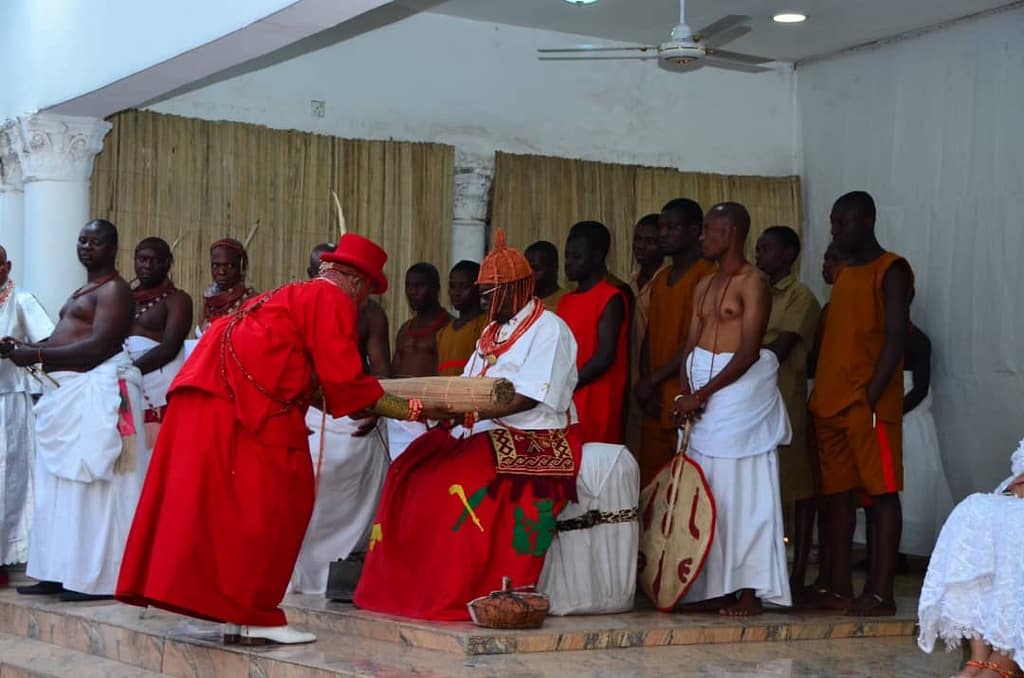

TRADITIONAL ẸDO/BENIN POST-MEAL GREETINGS:
KADA BU KPẸ • ẸRẸGHÌ GBUẸ • AREMEGBE
A DOCUMENTED CULTURAL AND LINGUISTIC RECORD
INTRODUCTION
Among the Ẹdo/Benin people, eating is traditionally accompanied by forms of respectful greeting, thanksgiving, blessing and response. These expressions are not merely equivalent to the English phrase “thank you.” They form part of a wider system of respect and social relationship surrounding food, elders, household authority and wellbeing.
Ẹdomaye Legacy Foundation records the following living Benin tradition while distinguishing it carefully from older historical documentation.
THE LIVING TRADITION
- MALE POST-MEAL GREETING
KADA BU KPẸ
Traditional male post-meal greeting.
In later Benin usage, KADA BU KPẸ is preserved as a fuller male form, while KADA is also commonly used as the shortened form.
- FEMALE POST-MEAL GREETING
ẸRẸGHÌ GBUẸ
Traditional female post-meal greeting.
In the living tradition documented by Ẹdomaye, this is especially associated with women/wives in the household.
- FULL WIFE-TO-HUSBAND FORMULA
ẸRẸGHÌ GBUẸ ENAEMWẸ NẸHÌ MWẸ
This is the fuller traditional formula preserved in the living Benin tradition in which a wife/mother addresses her husband/father after a meal.
The expression carries a protective and reverential character rather than functioning merely as an ordinary “thank you.”
- THE FATHER/HUSBAND’S RESPONSE
AREMEGBE
This is the traditional response preserved in the living tradition.
The historical form recorded by Melzian is “arè m-egbe,” which he explains as a formula meaning approximately:
“May eating be good for the body.”
Therefore, AREMEGBE is preserved here as the continuous traditional form, while the historical dictionary spelling is retained only as evidence for its older documentation.
THE HISTORICAL RECORD
Historical evidence confirms that post-meal greetings were an established part of Benin etiquette.
Hans Melzian’s 1937 A Concise Dictionary of the Bini Language of Southern Nigeria records:
KADA — a formula of giving thanks to the host after a meal, used by men.
BUKPẸ — a formula of thanks given by women after a meal.
Melzian also records AREMEGBE in the older form “arè m-egbe,” describing it as an answer to a junior person’s thanks for food and giving the sense:
“May eating be good for the body.”
J. U. Egharevba’s Benin Law and Custom independently records the post-meal distinction:
KADA — male
BUKPẸ — female
Egharevba describes these as salutations of reverence after meals and records that the same salutations were also used when an elderly person sneezed.
THE BUKPẸ QUESTION
BUKPẸ must not be erased from the historical record.
The older historical sources clearly document:
KADA = male
BUKPẸ = female
However, the living Benin tradition preserved by Ẹdomaye gives:
KADA BU KPẸ = male
ẸRẸGHÌ GBUẸ = female
Therefore, these forms must not be artificially collapsed into one form.
The safest scholarly conclusion is that the Benin post-meal greeting system has undergone historical development, with different formulaic forms being recorded at different periods.
BUKPẸ is historically attested as a female post-meal salutation.
KADA BU KPẸ is preserved in later/living Benin usage as a fuller male expression.
ẸRẸGHÌ GBUẸ is preserved in living Benin tradition as the female post-meal expression.
THE MEANING AND FUNCTION OF ẸRẸGHÌ GBUẸ
Historical linguistic evidence gives an important clue to the deeper meaning of the female formula.
Melzian records the older form èrèè in connection with an unknown other person or hostile force. He specifically notes its occurrence in a female thanksgiving formula after a meal and gives the protective sense that the bad wishes of other people should not kill the person being addressed.
This establishes an important semantic dimension:
ẸRẸGHÌ GBUẸ is not simply a female equivalent of “thank you.”
It belongs to a traditional system of protective and reverential blessing.
Later Benin usage also preserves ẸRẸ GHÌ GBUẸ as the female counterpart of male KADA.
ENAEMWẸ
The expression ENAEMWẸ is especially important in the wife-to-husband formula.
Ẹdo linguistic research from the University of Benin analyses ẸNA + MWẸ as “my owner” and discusses its use in respectful female speech toward a husband, recognizing his position as head of the household.
Therefore, in the traditional formula:
ẸRẸGHÌ GBUẸ ENAEMWẸ NẸHÌ MWẸ
ENAEMWẸ carries a respectful husband/household-head relationship.
The expression should not be casually reduced to the ordinary English word “husband,” because its traditional social meaning is broader.
AREMEGBE
AREMEGBE deserves special preservation.
The living traditional form is:
AREMEGBE
NOT:
Aremẹgbe
The historical Melzian form is:
arè m-egbe
and its documented meaning is approximately:
“May eating be good for the body.”
The lexical element EGBE is independently associated with “body” in Ẹdo.
Thus AREMEGBE is a traditional blessing-response concerning the beneficial effect of eating upon the body.
THE TRADITIONAL EXCHANGE
WIFE/MOTHER → HUSBAND/FATHER:
ẸRẸGHÌ GBUẸ ENAEMWẸ NẸHÌ MWẸ
HUSBAND/FATHER → WIFE/MOTHER:
AREMEGBE
CULTURAL FUNCTION
The exchange demonstrates that traditional Ẹdo/Benin post-meal speech is more than a simple expression of gratitude.
It combines:
FOOD
↓
THANKSGIVING
↓
RESPECT/REVERENCE
↓
PROTECTION AND BLESSING
↓
WELLBEING OF THE BODY
IMPORTANT SCHOLARLY CAUTION
Ẹdomaye Legacy Foundation distinguishes between:
- What is directly documented in historical sources;
- What is preserved in living Benin tradition;
- What is a linguistic interpretation requiring further scholarly verification.
Accordingly, Ẹdomaye does NOT claim that every syllable of:
ẸRẸGHÌ GBUẸ ENAEMWẸ NẸHÌ MWẸ
has been conclusively reconstructed word-for-word.
The protective/reverential function of ẸRẸGHÌ GBUẸ and the husband-directed meaning of ENAEMWẸ are strongly supported by the available evidence.
The precise grammatical analysis of NẸHÌ MWẸ requires further native-speaker and specialist linguistic verification.
This distinction is essential for responsible documentation of Ẹdo/Benin heritage.
FINAL ẸDOMAYE RECORD
MALE:
KADA BU KPẸ
FEMALE:
ẸRẸGHÌ GBUẸ
WIFE/MOTHER → HUSBAND/FATHER:
ẸRẸGHÌ GBUẸ ENAEMWẸ NẸHÌ MWẸ
HUSBAND/FATHER → WIFE/MOTHER:
AREMEGBE
CONCLUSION
The traditional Ẹdo/Benin post-meal greeting system is a culturally significant institution of respect, thanksgiving and blessing.
The living tradition preserves a gendered exchange in which the female formula carries a protective/reverential force toward the husband or household head, while the male response AREMEGBE invokes wellbeing through eating.
The historical record confirms that KADA and BUKPẸ were already established male and female post-meal salutations by the early twentieth century.
The living forms KADA BU KPẸ and ẸRẸGHÌ GBUẸ should therefore be preserved as part of the continuing development and transmission of Benin cultural practice.
Ẹdomaye Legacy Foundation presents this record as a documented cultural position, while leaving the remaining fine-grained grammatical questions open to formal linguistic verification.
ẸDO/ BENIN CULTURAL HERITAGE MUST BE DOCUMENTED.
WHAT OUR FATHERS AND MOTHERS PRESERVED MUST NOT BE LOST.
ẸDOMAYE LEGACY FOUNDATION
“WE ARE IN BENIN”
“FORWARD EVER, BACKWARD NEVER.”

Author: Edomaye Legacy Foundation
Edomaye Legacy Foundation preserves and promotes Edo language, culture, and heritage for learners and future generations. Through digital education, storytelling, and community programs, we ensure Edo traditions and knowledge are actively learned, celebrated, and passed on. Forward ever, backward never.