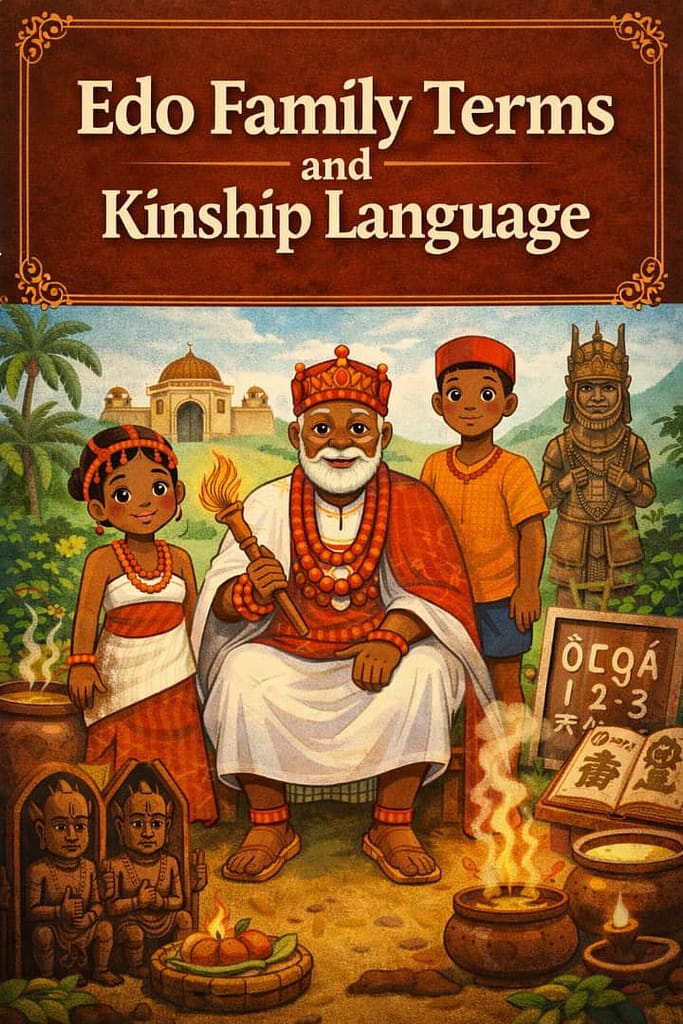
Edo Family Terms and Kinship Language

Family is the cornerstone of Edo society. Among the Edo people of present-dayEdo State and surrounding regions, kinship defines identity, social behavior,inheritance, authority, and moral responsibility. Edo family terms and kinshiplanguage are integral to how relationships are formed, maintained, andrespected.Unlike Western systems that emphasize the nuclear family, Edo kinship operateswithin an expansive framework that includes extended family, lineage, ancestors,and affinal relations (relations through marriage). Kinship terms are used daily ingreetings, conflict resolution, rituals, ceremonies, and governance. A child learnskinship language early, not only to identify relatives but to understand properconduct, respect, and obligation.This article provides a comprehensive exploration of Edo family terms and kinshiplanguage, tracing their structure, meanings, functions, and enduring relevance incontemporary Edo society.The Edo People and Language BackgroundThe Edo PeopleThe Edo people are indigenous to southern Nigeria, historically associated withthe Benin Kingdom—one of Africa’s most sophisticated pre-colonial states. Theirculture is known for its centralized monarchy (the Oba of Benin), advanced arttraditions, and strong social institutions.Edo LanguageEdo language belongs to the Edoid group of the Niger-Congo language family.Kinship terminology in Edo is deeply embedded in the language’s tonal,contextual, and hierarchical structure. Words for family relations often carryimplicit meanings about age, authority, gender, and social distance.The Edo Concept of FamilyFamily as a Social InstitutionIn Edo worldview, family (often understood as egbe or lineage-based units) ismore than blood ties. It includes:

Edo Family Terms and Kinship Language Read More »
whatsapp image 2025 12 07 at 22.16.18

Nagerian Linguafranca

The Erosion of Nigeria’s Linguistic Heritage: A Threat to Cultural Identity Nigeria, a nation boasting over 250 ethnic groups and more than 500 languages, is facing a looming crisis: the erosion of its linguistic heritage. The consequences of this phenomenon are far-reaching, threatening to undermine the very fabric of Nigerian culture and identity. The Perils of Language Erosion Language erosion, the gradual decline or loss of a language, is a pervasive issue in Nigeria. As globalization and urbanization continue to reshape the country’s linguistic landscape, indigenous languages are being increasingly marginalized. The repercussions of this trend are multifaceted: 1. *Cultural Identity Crisis*: Language is inextricably linked to culture and identity. As languages disappear, cultural heritage and traditional practices are also lost, leaving communities without a sense of roots or belonging. 2. *Communication Barriers*: Language erosion creates communication barriers, particularly among older generations or in rural areas, where indigenous languages are often the primary means of communication. 3. *Social Exclusion*: The decline of indigenous languages can lead to social exclusion, as individuals who do not speak the dominant language (often English) may be marginalized or excluded from social, economic, and political opportunities. The Compromise of Language: A Threat to Linguistic Diversity Language compromise, the alteration or simplification of a language to facilitate communication with non-native speakers, is another pressing concern in Nigeria. This phenomenon is driven by various factors, including: 1. *Globalization*: The increasing dominance of global languages like English has led to a decline in the use of indigenous languages in formal and informal settings. 2. *Urbanization*: The migration of people from rural areas to urban centers has resulted in language contact and the subsequent alteration of indigenous languages. 3. *Language Standardization*: Efforts to standardize languages can lead to the suppression of regional dialects and language variations, further compromising linguistic diversity. Preserving Nigeria’s Linguistic Heritage: A Call to Action To mitigate the effects of language erosion and language compromise, it is essential to adopt a multi-faceted approach that prioritizes language preservation, education, and promotion. Some strategies to consider include: 1. *Language Documentation*: Documenting indigenous languages through linguistic research, language mapping, and language archives can help preserve linguistic heritage. 2. *Language Education*: Promoting language education and literacy programs can support language preservation and revitalization. 3. *Language Revitalization*: Initiating language revitalization programs can help restore and promote endangered languages. 4. *Community Engagement*: Engaging with local communities and promoting language awareness can foster a sense of ownership and responsibility for language preservation. Conclusion The erosion of Nigeria’s linguistic heritage is a pressing concern that demands immediate attention. As we strive to promote linguistic diversity and preserve cultural identity, it is essential to recognize the importance of language in shaping our collective heritage. By adopting a proactive approach to language preservation, education, and promotion, we can ensure the long-term viability of Nigeria’s rich linguistic landscape.

Nagerian Linguafranca Read More »

Shopping Cart
Scroll to Top