
The Great Chief Behind the Story of Princess Adesuwa
A Living Heritage Story from the Kingdom of Benin
Before the story of Princess Adesuwa can be fully understood, we must first understand the man and institution behind her lineage:
The Ezomo of Uzebu.
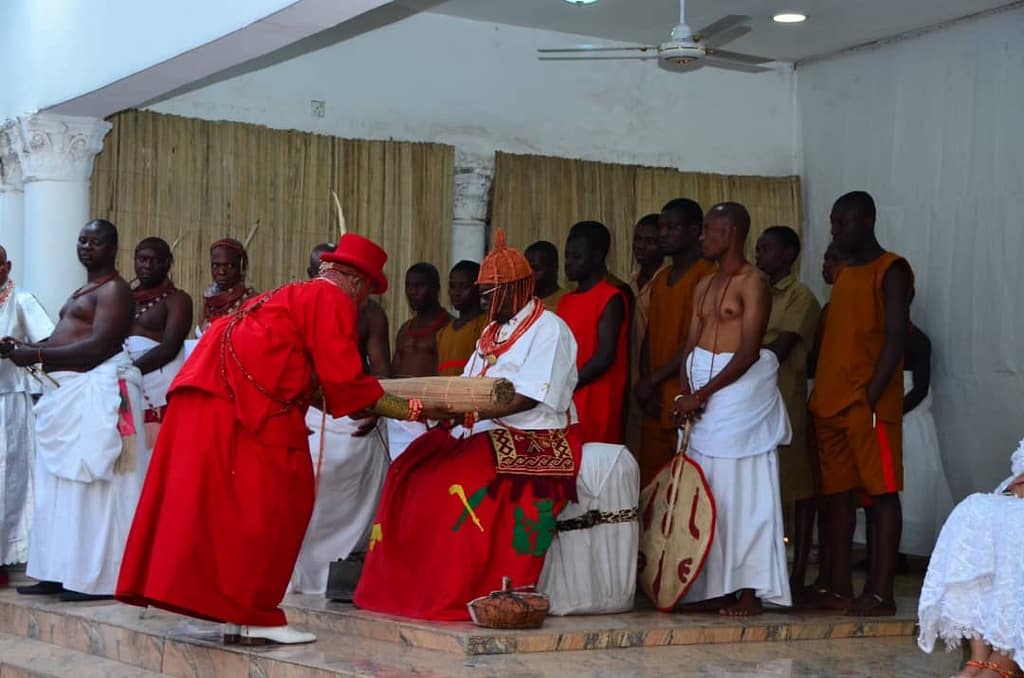
In the history and traditional political structure of the Benin Kingdom, the Ezomo was far more than simply a personal name or an ordinary chief.
The title represented authority, military leadership, political responsibility and a deep connection with Uzebu, one of the important quarters of Benin City.
Historical accounts describe the Ezomo as a major military figure and the traditional overlord of Uzebu. Jacob U. Egharevba described the Ezomo as the generalissimo of the State Army and the overlord of Uzebu.
This helps us understand why the story of Princess Adesuwa was never merely the story of a beautiful young woman.
It was connected to the household of one of the most powerful institutions in the Benin Kingdom.
THE EZOMO AND THE BENIN STATE
The Benin Kingdom developed a sophisticated system of political, military and palace authority.
The Oba stood at the centre of the kingdom, surrounded by institutions and titled chiefs whose responsibilities helped administer and defend the state.
The Ezomo occupied an important position within this structure.
A scholarly study of the Benin military system places the Ezomo among the senior military institutions of the kingdom and records hereditary Ezomos during the eighteenth century, including Ezomo Odia and Ezomo Ekenneza during the reign of Ọba Akengbuda.
This is important for the Adesuwa tradition.
It places her family within the world of Benin’s highest political and military leadership—not outside the centre of power.
UZEBU: THE HOME OF THE EZOMO
Uzebu was not merely a geographical location.
It was associated with the Ezomo institution and its authority.
The traditional history of Uzebu preserves accounts of successive Ezomos and their role in the development of Benin’s military and political history. One historical account of Uzebu traces the Ezomo institution to earlier military commanders and identifies Ekenika as an early bearer of the title, while later hereditary Ezomos became closely associated with the Ehenua lineage.
Thus, when tradition tells us that Adesuwa was the daughter of the Ezomo of Uzebu, the statement carries considerable historical significance.
She was born into a powerful political household.
EZOMO ODIA AND EZOMO EKENNEZA
There is an important point of historical caution here.
Different sources preserve different names and genealogical traditions concerning the Ezomos associated with the Adesuwa story.
Some Benin historical accounts identify Adesuwa as the daughter of Ezomo Odia, while other accounts identify Ezomo Ekenneza in connection with the period of Ọba Akengbuda.
A scholarly study of Benin’s military institutions lists:
Ezomo Odia — during the reigns of Eresoyen and Akengbuda
and
Ezomo Ekenneza — during the reign of Akengbuda.
For Ẹdomaye, this distinction matters.
We should not erase differences in historical tradition simply to make a story appear certain.
Instead, we preserve the traditions and clearly identify where further archival, oral-history and genealogical research is required.
That is how a heritage archive becomes trustworthy.
THE FATHER OF ADESUWA
The traditional story of Princess Adesuwa places her within the household of the Ezomo of Uzebu.
According to accounts of the Adesuwa tradition, she was betrothed to Ọba Akengbuda and became connected to the tragic events involving Obi Olise of Ubulu-Uku.
Her father’s position explains why the tragedy that followed could not be treated as an ordinary private dispute.
It touched:
Family.
Royal obligation.
Political authority.
Honour.
Diplomatic relations.
And ultimately—
war.
THE EZOMO, THE OBA AND THE PRINCESS
The relationship between the Ezomo’s household and the royal court is central to understanding the story.
The Princess was not simply a woman whose beauty attracted the attention of a foreign ruler.
She belonged to a powerful Benin household and, according to the tradition, was connected by betrothal to Ọba Akengbuda.
This transformed her fate into a matter with consequences far beyond her immediate family.
The tragedy of Adesuwa therefore became part of a much larger story about the political relationships between Benin and communities beyond the kingdom.
WHEN BEAUTY BECAME A POLITICAL MATTER
The traditional accounts tell of Obi Olise’s encounter with Adesuwa during his visit to Benin.
Accounts differ in their details concerning what happened afterwards.
Some traditions say that Adesuwa was drawn to Ubulu-Uku through a scheme involving an unpaid debt for goats. Other accounts emphasize the use of supernatural means or describe her movement to Ubulu-Uku differently.
The central point preserved in the tradition is that Adesuwa eventually died at the hands of Obi Olise.
Her death transformed a personal tragedy into a political crisis.
THE DEATH OF ADESUWA
The death of Princess Adesuwa is remembered as one of the most dramatic episodes associated with the reign of Ọba Akengbuda.
Her death was not remembered merely because she was beautiful.
It was remembered because of who she was, whose household she belonged to, her relationship with the Benin royal court, and the political consequences that followed.
Traditions of the episode connect her death with the military action launched by Benin against the community associated with Obi Olise.
The story therefore belongs within the wider history of Benin diplomacy, kingship, warfare and relations with neighbouring polities.
THE EZOMO AS A SYMBOL OF BENIN POWER
The story of the Ezomo reminds us that the Benin Kingdom was not governed by the Oba alone.
It was supported by a sophisticated network of institutions, chiefs, military commanders, royal officials and community authorities.
The Ezomo was one of those institutions.
That is why understanding the Ezomo helps us understand Benin itself.
The office represented:
Military command.
Political authority.
Territorial responsibility.
Royal service.
Hereditary tradition.
Community leadership.
And the preservation of ancestral memory.
BEYOND THE STORY OF ADE SUWA
For generations, the name Adesuwa has been associated primarily with beauty and tragedy.
Ẹdomaye must go further.
We must ask:
Who was her father?
What was the Ezomo institution?
Why was Uzebu important?
How did the Ezomo relate to the Oba?
What political structure existed around the royal court?
What did Adesuwa’s death reveal about Benin’s relationships with neighbouring kingdoms?
These questions transform a famous story into historical education.
THE HERITAGE LESSON
The greatest lesson of the Ezomo story is that history is rarely about one person alone.
Behind Adesuwa stood a family.
Behind the family stood the Ezomo institution.
Behind the Ezomo stood Uzebu.
Behind Uzebu stood the wider political and military structure of the Benin Kingdom.
And behind all of these stood a civilisation whose institutions deserve to be studied on their own terms.
That is the work of Ẹdomaye.
Not merely to repeat stories—
but to preserve, examine, connect and transmit them.
PRESERVING THE MEMORY
The story of the Ezomo of Uzebu should therefore remain part of the living heritage of the Benin Kingdom.
The surviving written records are important.
The oral traditions are important.
The genealogies are important.
The places are important.
The names are important.
And the differences between traditions are important too.
Where the evidence is certain, Ẹdomaye should speak with confidence.
Where traditions differ, Ẹdomaye should say so.
Where questions remain, Ẹdomaye should preserve the questions for future researchers.
This is how cultural memory becomes a serious heritage archive.
FROM EZOMO TO ADESUWA
The story does not end with the Ezomo.
It leads us back to Princess Adesuwa.
And from Adesuwa, it leads us to:
Ọba Akengbuda.
Oloi Idẹn.
Oboro-Uku.
Uzebu.
Benin’s royal women.
Benin’s military institutions.
And the wider story of the Kingdom of Benin.
One story opens another.
One name leads to another.
One generation hands its memory to the next.
And that is why we preserve.
ẸDOMAYE LEGACY FOUNDATION
Preserving Culture & Empowering Education
WE ARE IN BENIN
The stories of our ancestors are not dead.
They live whenever we remember them.
They live whenever we teach them.
They live whenever the next generation receives them.
ẸDOMAYE — preserving the living heritage of the Benin Kingdom.

Author: Otọdede James Ibieorutomwen
Otodede James Ibieorutomwen is the Founder and Executive Director of Ẹdomaye Legacy Foundation, a cultural and educational initiative dedicated to preserving, researching, documenting, and promoting the history, heritage, language, and cultural identity of the Great Benin Kingdom. Known as OTO THE WRITER, he is an Edo/Benin language teacher, researcher, writer, and lifelong student of Edo/Benin history and culture. Through Ẹdomaye Legacy Foundation, he is developing educational resources, eBooks, language-learning initiatives, cultural documentation, and research projects designed to make Edo/Benin knowledge accessible to present and future generations. His work is guided by a commitment to evidence-based research, cultural preservation, indigenous knowledge, and the responsible transmission of Edo/Benin language and heritage. ONLY THE BEST IS GOOD ENOUGH FOR ẸDOMAYE LEGACY FOUNDATION.