
The King, the Crisis and the Restoration of Benin
A Living Heritage Story from the Kingdom of Benin
The history of the Benin Kingdom is not a history of uninterrupted triumph.
It is also a history of crisis, struggle, reconciliation and renewal.
Among the kings whose reigns are remembered through stories of profound political and spiritual difficulty is Ọba Ewuakpe.
His story is inseparable from one of the most enduring traditions concerning a woman of the Benin royal household:
Oloi Idẹn.
But to understand Idẹn’s story properly, we must first understand the king whose reign formed its historical and traditional setting.
WHO WAS ỌBA EWUAKPE?
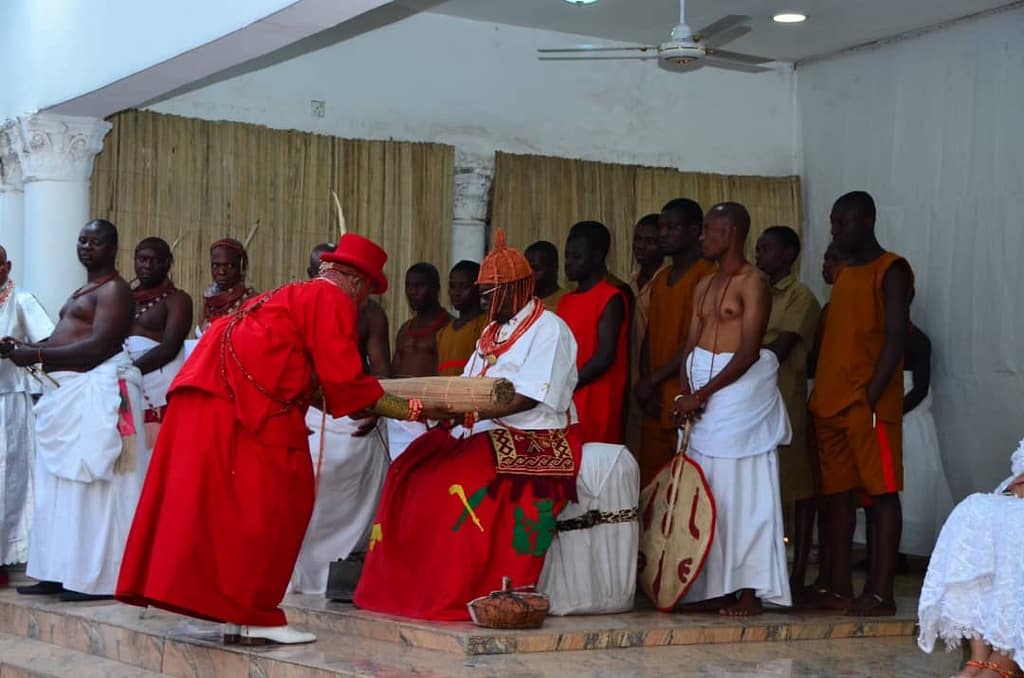
Ọba Ewuakpe was an Ọba of Benin whose reign is traditionally remembered as a period of serious internal crisis.
He occupies an important place in the traditional chronology of the Benin kings.
His reign is generally placed in the early eighteenth century.
The historical traditions surrounding him describe a kingdom experiencing tension between the palace and important sections of the political establishment.
This makes his story particularly valuable.
It reminds us that the strength of a kingdom is tested not only when everything is peaceful, but when institutions begin to pull apart.
A KINGDOM IN CRISIS
According to Benin traditions, Ọba Ewuakpe encountered serious opposition from sections of his chiefs.
The disagreement became so severe that the relationship between the palace and some of the kingdom’s political authorities broke down.
The king’s authority was challenged.
The palace became isolated.
The ordinary mechanisms through which the kingdom functioned were disrupted.
The crisis was therefore not simply a disagreement inside a royal household.
It became a crisis of governance.
And that distinction is essential.
THE EMPTYING OF THE PALACE
One of the most powerful elements of the traditional account is the image of a palace losing its people.
According to the tradition, some of the king’s wives left.
The chiefs withdrew their support.
The king became increasingly isolated.
The palace, which should have been the centre of political authority, was no longer functioning normally.
Yet one woman remained.
Oloi Idẹn.
Her decision to remain beside Ọba Ewuakpe is central to the tradition that has preserved her name.
OLOI IDẸN AND THE KING
The story of Ewuakpe cannot be separated from the story of Idẹn.
According to the traditional account, when others abandoned the king, Idẹn remained.
Her loyalty became one of the defining features of the story.
Eventually, the king sought a way to restore peace and stability.
Traditional accounts describe consultation with spiritual authorities and the performance of prescribed rites.
The story culminates in the extraordinary sacrifice associated with Oloi Idẹn.
For Ẹdomaye, this part of the tradition must be presented responsibly.
We preserve the historical and cultural memory of the story.
We do not advocate the ritual practices described in ancient traditions.
The value today lies in understanding what the story tells us about the beliefs, institutions and values of the society that transmitted it.
THE RESTORATION OF ROYAL AUTHORITY
The traditional narrative says that after Idẹn’s sacrifice, the crisis began to change.
The chiefs returned.
The palace regained its authority.
The kingdom moved toward reconciliation.
Peace was restored.
Whether every detail of this narrative can be independently verified through surviving documentary evidence is a question for historians, archaeologists, genealogists and other researchers.
But the tradition itself is historically significant because it demonstrates how Benin society remembered and explained a period of political crisis.
EWUAKPE AND THE MEANING OF KINGSHP
The story of Ọba Ewuakpe provides an important lesson about Benin kingship.
The Ọba was powerful.
But the kingdom was not operated by the king alone.
Benin’s political system depended upon relationships between the palace, chiefs, titled institutions, communities and other structures of authority.
When those relationships became strained, the entire political system could experience instability.
Ewuakpe’s story therefore allows us to examine kingship not simply as the story of an individual monarch, but as a complex institution.
THE ROLE OF THE CHIEFS
The chiefs were fundamental to the functioning of the Benin Kingdom.
They served different political, military, judicial, administrative and ceremonial roles.
Their relationship with the Ọba was therefore crucial.
The crisis remembered during Ewuakpe’s reign demonstrates what could happen when the relationship between the palace and powerful chiefs deteriorated.
It also reminds us that traditional institutions possessed their own histories, responsibilities and authority.
To understand Benin history properly, we must therefore study the institutions surrounding the Ọba as carefully as we study the kings themselves.
EWUAKPE AND THE MEMORY OF SACRIFICE
The story associated with Oloi Idẹn is one of sacrifice.
But Ẹdomaye must ask a deeper question:
Why did generations preserve this story?
One possible answer is that the story provided a powerful explanation for the restoration of social and political order.
Idẹn became the embodiment of loyalty.
Her story transformed personal sacrifice into a symbol of collective restoration.
This is one reason the story has survived so strongly in Benin cultural memory.
THE WOMEN OF THE BENIN KINGDOM
The story of Ewuakpe also gives us an opportunity to correct an imbalance in historical storytelling.
Too often, the history of African kingdoms is presented almost entirely through kings and male political figures.
But Benin’s history also contains the stories of queens, royal wives, mothers, daughters and women whose actions were remembered by their communities.
Oloi Idẹn is one of them.
Her story should not remain an isolated legend.
It should become an entry point into a larger study of:
Women.
Royal households.
Marriage alliances.
Political influence.
Cultural transmission.
Family networks.
And the preservation of Benin society.
THE HISTORICAL QUESTIONS
A responsible heritage archive must ask questions as well as tell stories.
Regarding Ọba Ewuakpe, researchers should continue examining:
- The chronology of his reign.
- The identities of the major chiefs associated with the crisis.
- The political circumstances behind the conflict.
- The relationship between palace authority and hereditary institutions.
- The historical development of the Oloi institution.
- Oral traditions surrounding Oloi Idẹn.
- Archaeological evidence associated with places connected to the tradition.
- Genealogical records preserved by Benin families.
- The transformation of the story through generations of oral transmission.
These questions do not weaken the tradition.
They strengthen the search for understanding.
THE IMPORTANCE OF ORAL HISTORY
Much of African history survived through oral transmission.
Benin is no exception.
Names, genealogies, titles, migrations, wars, traditions and memories were transmitted through generations.
That makes oral history an indispensable source.
But oral history must be carefully recorded.
Different families and communities may preserve different versions.
Some details may change over time.
Some names may be remembered differently.
Some traditions may contain symbolic elements.
The responsibility of Ẹdomaye is therefore not to silence differences.
It is to document them.
EWUAKPE AND THE LIVING HERITAGE OF BENIN
Ọba Ewuakpe’s story remains relevant because it raises timeless questions.
What happens when political institutions lose trust?
How does a society recover from internal division?
What holds a kingdom together?
What role does reconciliation play in leadership?
How are crises remembered by future generations?
And how do stories preserve the values that communities consider important?
These questions make the story of Ewuakpe more than an ancient royal narrative.
They make it a lesson in political memory.
FROM CRISIS TO RENEWAL
The most important part of the Ewuakpe tradition may not be the crisis itself.
It may be what comes afterwards.
A kingdom can experience division.
Institutions can clash.
Leadership can become isolated.
Communities can lose confidence.
But restoration remains possible.
The traditional memory of Ewuakpe is ultimately a story of movement:
Crisis → Sacrifice → Reconciliation → Restoration.
That sequence became part of the cultural memory surrounding his reign.
WHY ẸDOMAYE PRESERVES THIS STORY
Ẹdomaye is not preserving these stories simply to look backward.
We preserve them because a people without knowledge of its history can lose confidence in its own cultural identity.
The history of Benin contains sophisticated institutions, political traditions, military systems, artistic achievements, language, literature, oral history and community memory.
Ọba Ewuakpe’s story is one piece of that much larger heritage.
It deserves to be recorded alongside the stories of the kings, queens, chiefs, warriors, scholars, craftsmen and communities who shaped Benin history.
THE CHAIN OF MEMORY
The story now connects several important heritage figures and institutions:
Ọba Ewuakpe
↓
Oloi Idẹn
↓
The Royal Palace
↓
The Benin Chiefs
↓
The Political Crisis
↓
Reconciliation and Restoration
Each name opens another door.
Each door leads to another part of Benin history.
And this is how a digital heritage archive should grow.
Not as disconnected articles.
But as a living network of connected stories.
THE LEGACY OF ỌBA EWUAKPE
Ọba Ewuakpe’s legacy is therefore not simply that of a king who experienced difficulty.
It is the legacy of a reign remembered through a powerful story of crisis and restoration.
His story reminds us that kingdoms are human institutions.
They experience conflict.
They experience uncertainty.
They experience change.
But they can also recover.
The memory of Ewuakpe has survived because Benin people continued to tell the story.
Now another generation has the responsibility to preserve it.
ẸDOMAYE LEGACY FOUNDATION
Preserving Culture & Empowering Education
WE ARE IN BENIN
The story of Ọba Ewuakpe belongs to the living heritage of the Benin Kingdom.
His reign connects kingship, palace politics, chiefs, women, oral tradition, spirituality and the enduring search for social harmony.
We preserve the story.
We examine the evidence.
We honour the tradition.
And we teach the next generation.
ẸDOMAYE — Preserving Culture & Empowering Education.
WE ARE IN BENIN.
The leopard roars.
The memory lives.
The heritage continues.

Author: Otọdede James Ibieorutomwen
Otodede James Ibieorutomwen is the Founder and Executive Director of Ẹdomaye Legacy Foundation, a cultural and educational initiative dedicated to preserving, researching, documenting, and promoting the history, heritage, language, and cultural identity of the Great Benin Kingdom. Known as OTO THE WRITER, he is an Edo/Benin language teacher, researcher, writer, and lifelong student of Edo/Benin history and culture. Through Ẹdomaye Legacy Foundation, he is developing educational resources, eBooks, language-learning initiatives, cultural documentation, and research projects designed to make Edo/Benin knowledge accessible to present and future generations. His work is guided by a commitment to evidence-based research, cultural preservation, indigenous knowledge, and the responsible transmission of Edo/Benin language and heritage. ONLY THE BEST IS GOOD ENOUGH FOR ẸDOMAYE LEGACY FOUNDATION.