
The Institutions Behind the Ọba
Understanding the Political Architecture of the Benin Kingdom
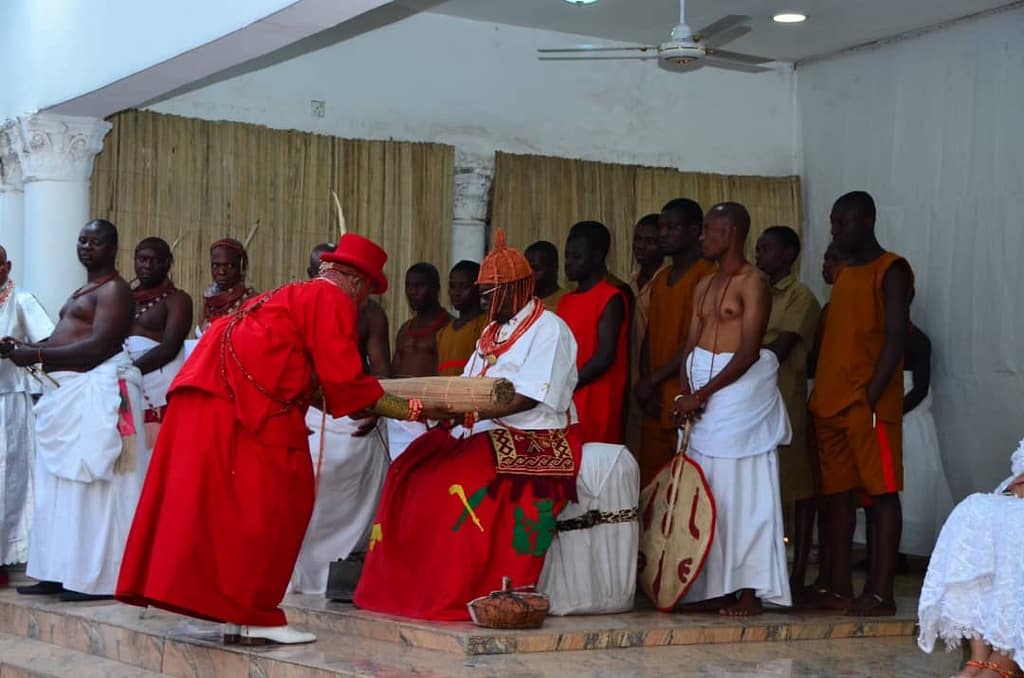
When people hear the history of the Kingdom of Benin, the first name they often encounter is the Ọba.
The Ọba stood at the centre of the kingdom.
But the Ọba did not govern a complex kingdom alone.
Around the throne stood a sophisticated network of chiefs, titled officials, palace societies, military commanders, hereditary leaders and community authorities.
Together, these institutions helped make Benin one of the most organized political systems in precolonial West Africa.
To understand the Ọba, therefore, we must understand the people and institutions surrounding the throne.
This is the story of the Benin Chiefs.
THE ỌBA AND THE INSTITUTIONS OF GOVERNMENT
The Benin Kingdom developed an elaborate system of authority.
The palace was the centre of royal power, but political responsibilities were distributed among different titled groups.
Some chiefs were closely associated with the palace.
Others exercised authority over communities and quarters.
Some held military responsibilities.
Others performed judicial, administrative, ceremonial or ritual functions.
The system was not static.
It developed over centuries as the kingdom expanded, adapted and responded to changing political circumstances.
This institutional complexity is one of the most important features of Benin history.
WHY THE CHIEFS MATTERED
A kingdom cannot function simply because a king possesses a title.
It requires institutions.
It requires people who administer decisions.
It requires commanders who organize defence.
It requires leaders who maintain relationships with communities.
It requires officials who preserve traditions and ceremonies.
It requires systems through which authority is communicated from the centre to the wider kingdom.
The Benin chiefs performed many of these functions.
They were therefore not merely attendants around a royal court.
They were part of the machinery through which the kingdom functioned.
THE THREE GREAT GROUPS OF CHIEFS
Traditional accounts of Benin political organization commonly distinguish major categories of chiefs and titled institutions.
Among the most important are the:
Uzama
Eghaevbo n’Oghe
Eghaevbo n’Ore
These groups had different historical origins, responsibilities and relationships with the palace.
They should not be treated as identical.
Understanding their distinctions is essential to understanding Benin governance.
THE UZAMA
The Uzama are among the oldest and most important titled groups associated with the Benin monarchy.
Traditional histories connect the Uzama with powerful hereditary chiefs whose authority predates or developed alongside important phases of the Benin monarchy.
The Uzama included powerful hereditary titleholders who played significant roles in the political structure of the kingdom.
Their relationship with the Ọba was therefore complex.
They supported the institution of kingship while also possessing their own hereditary authority.
This balance between royal authority and hereditary political institutions became a defining feature of Benin governance.
THE EGHaeVBO N’OGHE
The Eghaevbo n’Oghe are commonly associated with palace chiefs.
Their authority was closely connected to the royal palace and its administration.
The palace was not simply the residence of the Ọba.
It was a major political institution.
It was a centre of ceremony, administration, diplomacy, royal ritual and communication.
The chiefs connected with the palace helped maintain these functions.
Their offices demonstrate how deeply organized the Benin royal institution became.
THE EGHaeVBO N’ORE
The Eghaevbo n’Ore are commonly associated with town chiefs and community-based administration.
The word Ore is connected with the town or city.
These institutions helped connect the palace with the communities of Benin.
This distinction is important.
Benin political authority was not confined to the palace.
It extended into quarters, villages and communities through a network of titled leaders.
The result was a system in which the centre and the wider society remained politically connected.
THE EZOMO
The Ezomo deserves special attention.
We have already introduced the Ezomo of Uzebu through the story of Princess Adesuwa.
The Ezomo was a major title associated with military leadership and Uzebu.
Historical accounts describe the Ezomo as a senior military commander and the traditional overlord of Uzebu.
This tells us something important about Benin.
Military authority was institutionalized.
The kingdom did not depend upon an improvised army assembled only during emergencies.
It possessed established military leadership and traditions.
The Ezomo therefore belongs within the wider architecture of Benin state power.
CHIEFS AND THE MILITARY
Benin’s military organization was an important component of its political strength.
The kingdom expanded its influence through diplomacy, political relationships and warfare.
Military command required organization.
It required recruitment.
It required leadership.
It required logistics.
It required knowledge of territory.
It required communication between the palace and commanders.
Senior chiefs and titled military institutions played important roles in this structure.
The history of the Benin Kingdom cannot therefore be separated from the history of its chiefs.
CHIEFS AND THE OBAS
The relationship between the chiefs and the Ọba was not always simple.
There were moments of cooperation.
There were moments of disagreement.
There were periods when powerful chiefs challenged royal authority.
And there were periods when the palace strengthened its control.
The history of Ọba Ewuakpe illustrates why these relationships matter.
Traditional accounts of his reign remember a period of severe internal crisis involving the palace and important political authorities.
The story demonstrates a fundamental truth:
A powerful king still depends upon functioning institutions.
EWUAKPE AND THE LESSON OF INSTITUTIONAL POWER
The story of Ọba Ewuakpe should therefore not be remembered merely as a royal tragedy.
It can also be read as a lesson in governance.
When relationships between political institutions break down, the entire state can suffer.
The palace may remain physically standing.
The crown may remain on the king’s head.
But government becomes difficult when institutions no longer cooperate.
The restoration of political order therefore required more than the king’s personal authority.
It required reconciliation.
It required institutions to function again.
And it required the kingdom to regain political stability.
THE CHIEFS AS CUSTODIANS OF TRADITION
Benin chiefs were also important custodians of cultural memory.
Titles carried histories.
Families preserved genealogies.
Ceremonies preserved traditions.
Palace institutions transmitted knowledge.
Communities preserved local histories.
This means that a Benin chiefdom is not simply a political office.
It can also be a repository of historical memory.
For this reason, the study of Benin chiefs should include:
Genealogy.
Oral history.
Language.
Titles.
Ceremonies.
Political institutions.
Territorial history.
Material heritage.
TITLES ARE NOT JUST NAMES
One of the mistakes modern audiences can make is to see traditional titles simply as names placed before people’s names.
A title can contain centuries of history.
It may identify:
- A particular office.
- A hereditary lineage.
- A political responsibility.
- A military function.
- A community.
- A palace institution.
- A ceremonial responsibility.
- A relationship with the Ọba.
Therefore, when we preserve a Benin title, we are often preserving much more than a word.
We are preserving an institution.
THE PALACE AS A POLITICAL CENTRE
The Benin Palace was more than a royal residence.
It was a political centre.
It was a ceremonial centre.
It was a cultural centre.
It was a diplomatic centre.
And it was a place where the authority of the Ọba was expressed through a complex network of people and institutions.
The chiefs formed an essential part of that network.
They helped translate royal authority into functioning governance.
THE CHIEFS AND THE COMMUNITY
The relationship between chiefs and communities was equally important.
A kingdom could not be administered effectively from one palace alone.
Authority had to reach the people.
Information had to move back toward the centre.
Disputes had to be handled.
Communities had to organize themselves.
Traditional obligations had to be maintained.
Ceremonies had to be conducted.
The network of chiefs provided channels through which these relationships could operate.
WHY THIS MATTERS TODAY
The traditional institutions of Benin are not simply relics of a vanished past.
They remain important to understanding Benin identity and cultural heritage.
Modern government has replaced many functions once performed by traditional institutions.
But the titles, genealogies, ceremonies, histories and memories continue to carry cultural significance.
That makes documentation essential.
If the meaning of a title disappears, part of the historical record disappears with it.
THE CHIEFS AND THE MODERN HERITAGE ARCHIVE
Ẹdomaye’s responsibility is not to romanticize every historical tradition.
It is to preserve it carefully.
That means distinguishing between:
Documented history.
Oral tradition.
Genealogical memory.
Later interpretations.
Historical debate.
Where sources agree, we should state the evidence clearly.
Where traditions differ, we should identify the differences.
Where questions remain unanswered, we should preserve those questions for future researchers.
That is how a heritage archive becomes credible.
THE BENIN POLITICAL SYSTEM WAS COMPLEX
The story of the chiefs challenges the old idea that African kingdoms were governed through simple or purely personal authority.
Benin developed institutions.
It developed specialized offices.
It developed hereditary political structures.
It developed military organization.
It developed palace administration.
It developed systems of community leadership.
And these institutions evolved over generations.
The Ọba was at the centre.
But around the Ọba stood an entire political architecture.
THE LIVING HERITAGE
Today, when we speak the names of Benin titles, we should remember that each title may carry a story.
Uzama.
Eghaevbo n’Oghe.
Eghaevbo n’Ore.
Ezomo.
And many other titles and institutions.
Each deserves careful documentation.
Each deserves research.
Each deserves preservation.
And each deserves to be transmitted to future generations.
FROM THE CHIEFS TO THE KINGS
Now we can return to the individual rulers.
Because once we understand the institutions surrounding the throne, we can better understand the kings who occupied it.
The next major royal figure in our sequence is:
ỌBA AKENGBUDA
His reign provides another important window into Benin kingship.
It also reconnects us with the story of:
Princess Adesuwa.
Ezomo of Uzebu.
Oloi Idẹn.
The Benin palace.
The chiefs.
And the wider political world of the eighteenth-century kingdom.
The stories are not separate.
They are threads in one historical fabric.
THE ẸDOMAYE MISSION
Our mission is simple:
Preserve the names.
Preserve the language.
Preserve the institutions.
Preserve the stories.
Preserve the evidence.
Educate the next generation.
Because a people who know only the names of their kings but not the institutions that sustained their kingdom know only part of their history.
Ẹdomaye will tell the whole story.
One institution.
One title.
One person.
One community.
One generation at a time.
ẸDOMAYE LEGACY FOUNDATION
Preserving Culture & Empowering Education
WE ARE IN BENIN
The Benin Kingdom was not built by one person.
It was built through institutions.
It was sustained by communities.
It was defended by organized leadership.
It was remembered through language and tradition.
And it was transmitted from generation to generation.
The chiefs were part of that great architecture.
ẸDOMAYE — Preserving Culture & Empowering Education.
WE ARE IN BENIN.
The leopard roars.
The memory lives.
The heritage continues.

Author: Otọdede James Ibieorutomwen
Otodede James Ibieorutomwen is the Founder and Executive Director of Ẹdomaye Legacy Foundation, a cultural and educational initiative dedicated to preserving, researching, documenting, and promoting the history, heritage, language, and cultural identity of the Great Benin Kingdom. Known as OTO THE WRITER, he is an Edo/Benin language teacher, researcher, writer, and lifelong student of Edo/Benin history and culture. Through Ẹdomaye Legacy Foundation, he is developing educational resources, eBooks, language-learning initiatives, cultural documentation, and research projects designed to make Edo/Benin knowledge accessible to present and future generations. His work is guided by a commitment to evidence-based research, cultural preservation, indigenous knowledge, and the responsible transmission of Edo/Benin language and heritage. ONLY THE BEST IS GOOD ENOUGH FOR ẸDOMAYE LEGACY FOUNDATION.