
The King, His Court and the World of Eighteenth-Century Benin
A Living Heritage Story from the Kingdom of Benin
The history of the Kingdom of Benin is carried not only in monuments, royal regalia and ancient institutions.
It is also carried in the names of its kings.
Among the rulers whose names remain deeply connected with the historical memory of Benin is Ọba Akengbuda.
His reign belongs to the eighteenth-century history of the kingdom, a period in which Benin’s political institutions, royal court, military organization and relationships with neighbouring communities continued to develop.
To understand Akengbuda is therefore to enter a wider world:
The Ọba.
The palace.
The chiefs.
The royal household.
The military institutions.
The communities beyond Benin City.
And the stories through which later generations remembered this period.
WHO WAS ỌBA AKENGBUDA?
Ọba Akengbuda was an Ọba of Benin whose reign is traditionally placed in the eighteenth century.
He inherited a kingdom with established institutions of kingship, hereditary chiefs, palace officials, military organizations and community leadership.
His reign therefore needs to be understood within the long development of the Benin state.
He was not building a kingdom from nothing.
He was inheriting and exercising authority within a civilization that had already developed complex systems of government.
THE BENIN THRONE
The authority of the Ọba was central to the political life of Benin.
But the throne existed within a network of institutions.
The king depended upon titled chiefs.
The chiefs depended upon established offices.
Communities maintained their own structures.
Military commanders organized defence.
The palace coordinated royal affairs.
Ceremonies reinforced the legitimacy of kingship.
Akengbuda therefore ruled through an institutional system whose origins stretched far beyond his own reign.
This is one reason why the study of his reign is so important.
It allows us to see Benin kingship as an institution rather than merely as an individual personality.
AKENGBUDA AND THE ROYAL COURT
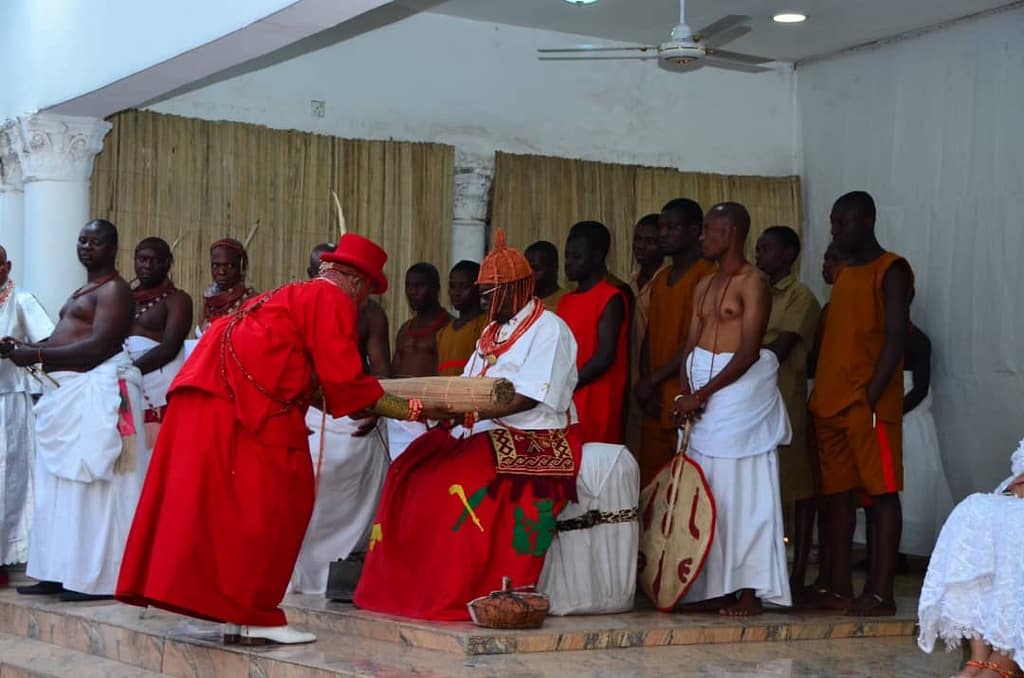
The royal court was one of the most important centres of Benin political and cultural life.
It was a place where political decisions were made.
It was where royal ceremonies were performed.
It was where diplomatic relationships were managed.
It was where titled officials carried out their responsibilities.
It was also a centre of cultural memory.
The royal household included the Ọba, Oloi and other members of the palace community.
Behind the formal image of the king was therefore a complex human and institutional environment.
THE CHIEFS DURING AKENGBUDA’S REIGN
The chiefs remained fundamental to the functioning of the kingdom.
Among the important institutions were hereditary and palace-based titles whose holders exercised political, military and ceremonial responsibilities.
The Ezomo is particularly significant in the history associated with Akengbuda.
Historical studies of Benin’s military institutions identify Ezomo Odia and Ezomo Ekenneza in connection with the eighteenth-century period and the reign of Akengbuda.
This illustrates the continuing importance of organized military leadership within the kingdom.
The throne was therefore supported by institutions with responsibilities that extended far beyond the palace.
THE EZOMO AND AKENGBUDA
The story of Princess Adesuwa provides one of the best-known traditional narratives connected with Akengbuda.
In that tradition, Adesuwa is associated with the household of the Ezomo of Uzebu.
The story eventually connects the Benin court with events involving Obi Olise of Ubulu-Uku.
It is important, however, to distinguish the traditional narrative from independently verified historical details.
The story has been preserved through oral tradition and later written accounts.
Its cultural importance is unquestionable as a piece of Benin historical memory.
But where different traditions disagree over names, dates or genealogies, Ẹdomaye should preserve those differences rather than turn uncertain details into absolute fact.
PRINCESS ADESUWA
The story of Princess Adesuwa belongs among the most dramatic traditions associated with the reign of Ọba Akengbuda.
She is remembered as a royal woman whose fate became connected with political consequences between Benin and Ubulu-Uku.
Her story has already been preserved in the Ẹdomaye heritage archive.
That page should therefore be linked here rather than repeating the entire narrative.
The important point for this article is that Adesuwa’s story reveals the wider world surrounding Akengbuda’s throne.
It brings together:
Royal marriage.
Chiefly authority.
Military power.
Diplomatic relationships.
Women of the royal household.
Neighbouring communities.
And the consequences of conflict.
THE WORLD BEYOND THE PALACE
A king’s history cannot be understood solely by looking inside the palace.
Benin maintained relationships with neighbouring communities and kingdoms.
Trade, migration, marriage, diplomacy, conflict and political competition all shaped the wider region.
The story associated with Ubulu-Uku is therefore important because it takes us beyond the walls of Benin City.
It reminds us that the Benin Kingdom existed within a larger West African political landscape.
AKENGBUDA AND MILITARY POWER
Military organization was essential to the security of the Benin Kingdom.
The kingdom had established military traditions and titled commanders.
The Ezomo was one of the important institutions associated with military leadership.
Other military offices and community structures also contributed to the kingdom’s defence.
The ability to mobilize organized forces was part of the power of the Benin state.
This should be understood as an institutional achievement rather than merely a story of individual warriors.
AKENGBUDA AND THE ROYAL WOMEN
The history of Akengbuda also provides an opportunity to examine the women of the Benin palace.
Royal women were not simply decorative figures surrounding the throne.
They belonged to families, lineages and political networks.
Marriage could connect households.
Royal women could carry traditions between generations.
They could influence relationships within the palace and beyond it.
The story of Princess Adesuwa is one example of how the life of a royal woman could become connected to wider political events.
THE IMPORTANCE OF OLOI
In Ẹdo tradition, Oloi is the title used for a wife of the Ọba.
The Oloi therefore belonged to the institution of the royal household.
This terminology must be preserved accurately.
Language is part of history.
When we use the correct Edo term, we preserve not only the person’s identity but also the cultural system in which that title had meaning.
Ẹdomaye will therefore continue to document the Oloi as an important part of Benin royal history.
AKENGBUDA AND THE INSTITUTIONS OF BENIN
Akengbuda’s reign allows us to bring together several strands of the Benin political system.
The Ọba stood at the centre.
The chiefs exercised their offices.
The palace operated through specialized institutions.
Military commanders maintained defence.
Communities maintained local structures.
Royal women formed part of the palace household.
And traditions transmitted memories of important events.
This was not a simple political system.
It was a complex civilization.
HISTORY AND TRADITION
A serious heritage archive must make an important distinction.
There is a difference between:
Historical evidence
and
Historical tradition.
Both matter.
Written records are important.
Archaeological evidence is important.
Oral history is important.
Genealogy is important.
Community memory is important.
But each source must be evaluated according to its nature.
A traditional story should not automatically be dismissed because it is oral.
Nor should every detail of an oral tradition automatically be treated as independently verified history.
Ẹdomaye’s role is to preserve the tradition while encouraging careful research.
WHY AKENGBUDA MATTERS TODAY
Why should a twenty-first-century generation study an eighteenth-century Benin king?
Because history gives identity context.
Without knowing the institutions that shaped earlier generations, it becomes difficult to understand the cultural world inherited today.
Akengbuda’s story opens questions about:
Kingship.
Leadership.
Political institutions.
Military organization.
Royal women.
Diplomacy.
Community relations.
Language.
Historical memory.
These are not dead questions.
They remain part of the study of Benin heritage.
FROM KING TO KINGDOM
The greatest mistake would be to study Akengbuda only as a man.
He should be studied as a ruler within a civilization.
His reign provides a window into the kingdom.
Through him, we can examine the palace.
Through the palace, we can examine the chiefs.
Through the chiefs, we can examine the communities.
Through the communities, we can examine the wider kingdom.
And through the kingdom, we can understand the civilization that created one of Africa’s most remarkable historical legacies.
THE AKENGBUDA HERITAGE CHAIN
The Ẹdomaye archive can now connect the following stories:
Ọba Akengbuda
↓
Princess Adesuwa
↓
Ezomo of Uzebu
↓
Obi Olise of Ubulu-Uku
↓
Benin–Ubulu-Uku Relations
↓
The Benin Chiefs
↓
The Royal Women of Benin
Each page should link to the others.
This transforms Ẹdomaye.com from a collection of posts into a connected digital heritage archive.
A RESPONSIBILITY TO THE FUTURE
The work of preserving Benin history belongs to every generation.
Our ancestors preserved their memories through oral tradition, institutions, ceremonies, objects, names and places.
Our generation has additional tools.
We have:
Digital archives.
Websites.
Video.
Audio recording.
Photography.
Academic research.
Social media.
These tools give us an extraordinary opportunity.
We can ensure that the names of Benin’s kings, queens, chiefs, women, warriors and communities are not lost.
THE LIVING HERITAGE OF AKENGBUDA
Ọba Akengbuda belongs to a long line of Benin rulers.
His reign forms one chapter in the continuing story of the kingdom.
His name is connected with a period of political and military organization, royal institutions, neighbouring relationships and enduring oral traditions.
But the work does not end with remembering his name.
We must ask the deeper questions.
Who served under him?
Who advised him?
Who defended the kingdom?
Who lived within the palace?
Who preserved the stories?
Who transmitted the language?
Who remembered the events?
Those questions lead us from the king back to the people.
And that is where history becomes truly alive.
ẸDOMAYE’S PROMISE
Ẹdomaye will not preserve Benin history as a collection of isolated names.
We will preserve the connections.
The kings.
The Oloi.
The chiefs.
The military institutions.
The communities.
The language.
The traditions.
The places.
The stories.
The evidence.
And the questions still waiting for answers.
Because heritage is not simply something we inherit.
It is something we have a responsibility to transmit.
ẸDOMAYE LEGACY FOUNDATION
Preserving Culture & Empowering Education
WE ARE IN BENIN
The story of Ọba Akengbuda is part of the living historical memory of the Kingdom of Benin.
His reign connects the throne to the chiefs.
The palace to the communities.
The military institutions to the wider kingdom.
And the stories of royal women to the political history of their time.
We remember.
We research.
We preserve.
We teach.
We transmit.
ẸDOMAYE — Preserving Culture & Empowering Education.
WE ARE IN BENIN.
The leopard roars.
The memory lives.
The heritage continues.

Author: Otọdede James Ibieorutomwen
Otodede James Ibieorutomwen is the Founder and Executive Director of Ẹdomaye Legacy Foundation, a cultural and educational initiative dedicated to preserving, researching, documenting, and promoting the history, heritage, language, and cultural identity of the Great Benin Kingdom. Known as OTO THE WRITER, he is an Edo/Benin language teacher, researcher, writer, and lifelong student of Edo/Benin history and culture. Through Ẹdomaye Legacy Foundation, he is developing educational resources, eBooks, language-learning initiatives, cultural documentation, and research projects designed to make Edo/Benin knowledge accessible to present and future generations. His work is guided by a commitment to evidence-based research, cultural preservation, indigenous knowledge, and the responsible transmission of Edo/Benin language and heritage. ONLY THE BEST IS GOOD ENOUGH FOR ẸDOMAYE LEGACY FOUNDATION.