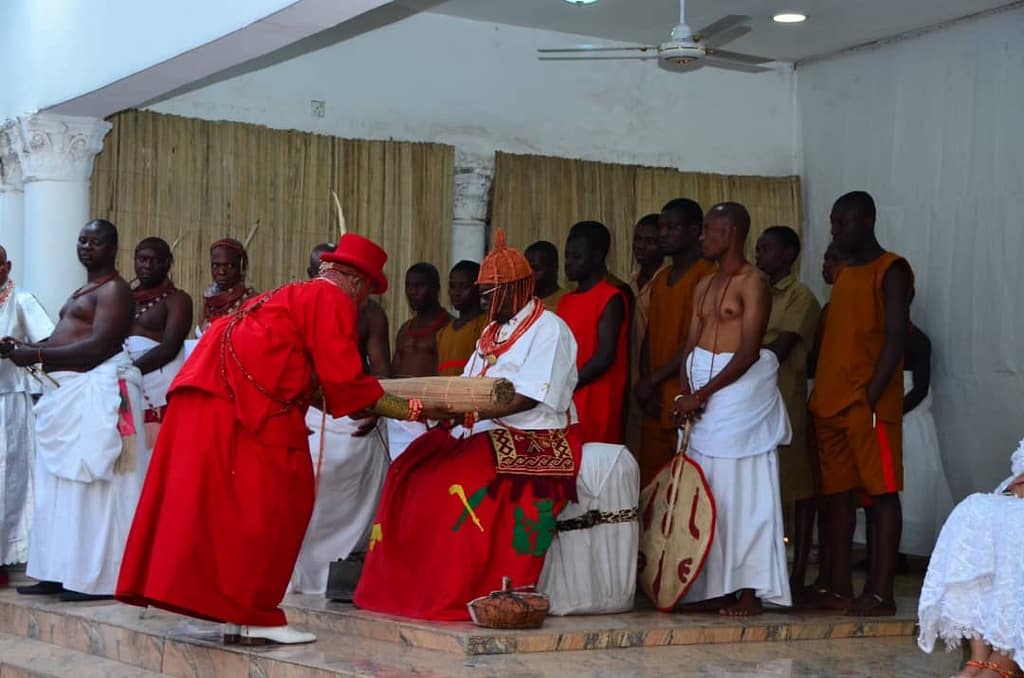

The Man at the Centre of a Benin Royal Tradition
A Living Heritage Story Linking Benin and Ubulu-Uku
The history of the Kingdom of Benin cannot be fully understood by looking only within the walls of the royal palace.
Benin’s history was also shaped by its relationships with neighbouring communities and kingdoms.
Among the traditions that preserve such a relationship is the story of Obi Olise of Ubulu-Uku.
His name is inseparably connected with one of the most enduring stories associated with the reign of Ọba Akengbuda:
the story of Princess Adesuwa.
This is therefore not merely the story of one man.
It is a story about royal relationships, neighbouring communities, political authority, memory and the way a personal tragedy can become part of the historical tradition of two societies.
WHO WAS OBI OLISE?
Obi Olise is remembered in Benin and Ubulu-Uku traditions as a ruler of Ubulu-Uku associated with the period of Ọba Akengbuda.
The traditional narrative places him at the centre of the events surrounding Princess Adesuwa.
Because much of the story has survived through oral tradition and later written accounts, individual details should be treated carefully.
Ẹdomaye’s responsibility is therefore to preserve the tradition while distinguishing between what is documented, what is traditionally remembered and what remains open to further research.
UBULU-UKU
To understand Obi Olise, we must understand Ubulu-Uku.
Ubulu-Uku is an ancient community in present-day Delta State.
Its history is deeply connected with the wider history of the Niger Delta and the communities surrounding the Benin cultural sphere.
The relationship between Benin and neighbouring communities was not always defined by one simple pattern.
There could be:
Trade.
Migration.
Marriage.
Political relationships.
Cultural exchange.
Conflict.
Alliance.
The story of Obi Olise belongs within this larger regional history.
THE ADESUWA TRADITION
The best-known tradition connecting Obi Olise with Benin concerns Princess Adesuwa.
According to the traditional account, Obi Olise encountered Adesuwa during a visit associated with Benin.
Different versions preserve different details concerning how she eventually came to Ubulu-Uku.
Some accounts describe deception involving a debt.
Other traditions preserve supernatural elements.
These differences should not simply be erased.
They are evidence of how oral traditions can develop through transmission.
The central element of the tradition, however, is consistent in its broad outline:
Adesuwa became connected with Obi Olise and Ubulu-Uku, and her death eventually produced a grave political confrontation.
THE DEATH OF PRINCESS ADESUWA
The death of Adesuwa is the point at which the personal story becomes political.
She was not remembered simply as an ordinary woman.
The tradition connects her to the Benin royal household and the Ezomo of Uzebu.
Her death therefore carried implications far beyond an individual relationship.
It touched:
Royal honour.
Family honour.
Political authority.
Diplomatic relations.
Military power.
And the authority of the Benin throne.
This is why the story survived.
AKENGBUDA AND OLISE
The traditional narrative connects Obi Olise’s actions with the response of Ọba Akengbuda.
According to the story, the Benin king regarded the death of Adesuwa as an intolerable offence.
A military response followed.
Here again, Ẹdomaye must distinguish the historical tradition from independently verified documentary evidence.
The tradition is important because it preserves how later generations understood the relationship between Benin authority and Ubulu-Uku.
It should therefore be studied rather than simply repeated without examination.
WHEN A PERSONAL STORY BECAME A POLITICAL CRISIS
The story demonstrates an important principle of precolonial politics.
Royal marriages and relationships were rarely purely private matters.
They could involve families.
They could involve lineages.
They could involve political alliances.
And when a royal household was insulted or harmed, the consequences could extend into diplomacy and warfare.
In the tradition surrounding Adesuwa, the personal became political.
And the political became historical memory.
BENIN AND ITS NEIGHBOURS
The story of Obi Olise reminds us that Benin did not exist in isolation.
The kingdom interacted with numerous neighbouring peoples.
Some relationships were peaceful.
Some were commercial.
Some were diplomatic.
Some were competitive.
Some were violent.
The history of Benin must therefore be studied as part of a wider regional system.
This is why the Ubulu-Uku connection deserves a dedicated place in the Ẹdomaye archive.
THE LIMITS OF THE TRADITION
A responsible heritage platform must also acknowledge uncertainty.
The story of Obi Olise has been transmitted through generations.
Oral traditions can preserve remarkable historical memories.
But they can also change through time.
Names may be remembered differently.
Dates may become uncertain.
Events may acquire symbolic elements.
Different communities may preserve different versions.
This does not make the traditions worthless.
It makes careful documentation even more important.
BENIN MEMORY AND UBULU-UKU MEMORY
One of the most interesting aspects of the story is that it belongs to more than one community.
Benin remembers Adesuwa.
Ubulu-Uku preserves traditions concerning Obi Olise.
Each community therefore possesses part of the larger historical memory.
The task of modern researchers is not to force one community’s version to erase another.
The task is to place the traditions beside one another and investigate their relationships.
This is where oral history, genealogy, archaeology, linguistics and written records can work together.
WHY OBI OLISE MATTERS
Obi Olise matters to the Ẹdomaye archive because his story opens a door into a larger historical question:
How did Benin relate to neighbouring societies?
The answer cannot be reduced to warfare.
Relationships between societies are multidimensional.
People moved.
Languages influenced one another.
Families interacted.
Goods circulated.
Ideas travelled.
Political authority expanded and contracted.
Memories crossed boundaries.
The Obi Olise tradition provides one entry point into this complex world.
THE STORY OF ADE SUWA AS A BRIDGE
The story now forms a powerful historical chain:
Ọba Akengbuda
↓
Princess Adesuwa
↓
Ezomo of Uzebu
↓
Obi Olise
↓
Ubulu-Uku
↓
Benin’s relationship with neighbouring communities
Each link deserves independent study.
The purpose of the Ẹdomaye archive is to make these connections visible.
WHAT WE STILL NEED TO RESEARCH
The story of Obi Olise raises important research questions.
Who exactly was Obi Olise?
What is the chronology of his reign?
What genealogical traditions survive in Ubulu-Uku?
What traditions survive in Benin concerning Adesuwa?
What locations are associated with the story?
What archaeological evidence exists?
What independent written sources mention the relationship?
How did the tradition change over time?
How do Benin and Ubulu-Uku versions compare?
These are not weaknesses in the story.
They are opportunities for scholarship.
THE VALUE OF ORAL HISTORY
For generations, communities preserved their histories without modern recording equipment.
Stories were transmitted through:
Speech.
Songs.
Proverbs.
Genealogies.
Ceremonies.
Names.
Places.
Family traditions.
The survival of the Obi Olise tradition demonstrates the power of this cultural system.
Today, however, we have the opportunity to record these traditions carefully before further details disappear.
ẸDOMAYE’S ROLE
Ẹdomaye should become a bridge between:
Community memory
and
documented scholarship.
We should encourage elders to tell their stories.
We should record the correct Edo terminology.
We should document names and genealogies.
We should preserve photographs and places.
We should compare oral traditions with historical sources.
And we should teach young people how to distinguish tradition, evidence and interpretation.
That is cultural preservation with intellectual responsibility.
BEYOND THE TRAGEDY
It would be easy to remember Obi Olise only as the man associated with the tragedy of Princess Adesuwa.
But history should go further.
We should ask who he was as a ruler.
What was Ubulu-Uku like during his period?
What political institutions existed?
What was the relationship between Ubulu-Uku and neighbouring communities?
What economic networks existed?
What cultural connections existed with Benin?
Those questions may reveal a much larger history.
THE NEXT CHAPTER
The story of Obi Olise leads naturally to the next major subject:
BENIN AND UBULU-UKU
That article should examine the relationship between the two societies beyond the Adesuwa story.
It should investigate:
Political relations.
Migration.
Trade.
Cultural exchange.
Warfare and diplomacy.
Oral traditions.
Shared and disputed memories.
That will take the Ẹdomaye archive from biography into regional history.
A STORY THAT CONNECTS TWO HISTORIES
The significance of Obi Olise is therefore larger than his individual name.
His story connects:
Benin
with
Ubulu-Uku.
It connects:
the palace
with
the wider region.
It connects:
a royal woman
with
political history.
And it connects:
oral tradition
with
modern historical research.
This is why the story deserves preservation.
ẸDOMAYE LEGACY FOUNDATION
Preserving Culture & Empowering Education
WE ARE IN BENIN
The story of Obi Olise belongs to a larger history of relationships between peoples.
We preserve the tradition.
We respect the communities that carry it.
We investigate the evidence.
We acknowledge uncertainty where it exists.
And we open the door for future generations to continue the research.
Because history becomes stronger when memory is preserved responsibly.
ẸDOMAYE — Preserving Culture & Empowering Education.
WE ARE IN BENIN.
The leopard roars.
The memory lives.
The heritage continues.

Author: Otọdede James Ibieorutomwen
Otodede James Ibieorutomwen is the Founder and Executive Director of Ẹdomaye Legacy Foundation, a cultural and educational initiative dedicated to preserving, researching, documenting, and promoting the history, heritage, language, and cultural identity of the Great Benin Kingdom. Known as OTO THE WRITER, he is an Edo/Benin language teacher, researcher, writer, and lifelong student of Edo/Benin history and culture. Through Ẹdomaye Legacy Foundation, he is developing educational resources, eBooks, language-learning initiatives, cultural documentation, and research projects designed to make Edo/Benin knowledge accessible to present and future generations. His work is guided by a commitment to evidence-based research, cultural preservation, indigenous knowledge, and the responsible transmission of Edo/Benin language and heritage. ONLY THE BEST IS GOOD ENOUGH FOR ẸDOMAYE LEGACY FOUNDATION.